What Did Flint’s Pipe Replacement Program Actually Dig Up and Replace?
If you hear that Flint replaced its lead pipes, it is reasonable to ask what that means at a particular home. A service line is only one part of a water system, and construction work does not necessarily include every pipe indoors. This article explains what the project addressed, what its reported completion does and does not establish, and how to check what happened at an individual property.
What a service line is—and what it is not
A water system has several connected parts. Water travels through a main, usually located beneath a street or other public space, and reaches a property through a smaller service line. That line connects the public water system to a building. Inside the building, plumbing carries water onward to faucets and appliances.
The service line is the part most directly associated with Flint’s replacement project. It is not the same thing as the water main, the meter, or all the plumbing inside a home. Those distinctions matter because a statement about replacing a service line cannot, by itself, confirm the material or condition of every pipe connected to it.
A service line may also have sections on different sides of a property boundary. People often refer to these as the public or utility side and the private or customer side. The boundary can affect who owns a section, who arranges work, and who is responsible for repairs. But ownership boundaries and construction scope are not interchangeable: a property line does not tell you which sections were replaced during a particular job.
For a closer look at how the sections relate, see Utility Side vs. Private Side: Does Michigan Replacement Cover Both?. If you are trying to identify the material at your own address, How to Tell Whether Your Michigan Service Line Is Lead explains the kinds of records and inspections that may help.
A service line also should not be confused with a water meter. The meter measures water use for billing and system operations; it is not the pipe that connects the main to a building. According to the City of Flint, water meters are mandatory for all City of Flint water customers. That requirement is separate from whether an individual service line or indoor plumbing contains lead.
| Part of the system | What it does | What a service-line replacement statement tells you |
|---|---|---|
| Water main | Carries water through the public distribution system | It does not, by itself, say that the main was replaced |
| Service line | Connects the water main to a building | This is the kind of connection the lead-line project addressed |
| Water meter | Measures water use | Its presence does not identify the materials in nearby pipes |
| Indoor plumbing | Carries water through the building to fixtures | A service-line project statement alone does not confirm that indoor pipes were replaced |
| Faucet or fixture | Delivers water for household use | Its condition and materials are not established by a statement about a buried line |
The table is a way to keep the terms straight, not a record of the work at any particular address. A project may affect one system component without changing the others. The most reliable way to understand a specific property is to match its address to the City’s records and, if needed, ask what the documented work included.
This distinction is especially important for older buildings. A replacement outside or beneath a yard may leave plumbing inside the building untouched. Conversely, indoor plumbing work does not establish that the buried service line was replaced. To understand the remaining possibilities, see Lead After Line Replacement: What Can Linger in Michigan Home Plumbing and Faucets, Solder and Galvanized Pipe: Indoor Lead Sources Left Behind.
What the Flint project replaced—and what completion means
The City of Flint describes its work as a lead service line replacement project. According to the City of Flint, Over 97% of replacements have been completed. The City also states that the project has reached completion and that it completed replacement of the final active lead service line identified through a federal settlement agreement.
Those statements describe the project’s reported status. They do not give an address-by-address account of every pipe segment, nor do they establish that all plumbing in every building is free of lead. The project’s stated focus is lead service lines. That is an important part of the water connection, but it is not a substitute for checking other parts of a property’s plumbing.
It is helpful to read “completed” with the project’s stated scope in mind. The City’s announcement about the final active line identified through the federal settlement agreement is specific to that identified line. It should not be expanded into a claim that every possible lead-containing component in Flint homes, businesses, or public infrastructure was removed. A service line inventory and records of completed work are more useful for answering what happened at a particular address.
There is also a difference between the number of completed jobs and what an individual customer knows about their own connection. A citywide completion report gives an overview of program progress. A household may still need address-level documentation to understand whether its line was found, what material was recorded, what work was done, and whether any portion was left in place.
The City’s reported status is a significant milestone, but it is not an individual water test or a plumbing inspection. Nor does it describe the condition of faucets, fixtures, solder, interior pipes, or plumbing alterations made after the project work. These are separate questions that require separate information.
If you have a City letter, work notice, or record tied to your home, keep it with property documents. Check whether it identifies the address and clearly describes the completed work, rather than relying only on a neighborhood update or a broad project announcement. If a record uses a term such as “unknown,” ask what that designation means and whether it refers to the line’s material, the status of inspection, or the status of replacement. Service Line Marked Unknown, or No Notice Came? Next Steps in Michigan covers how to approach that kind of uncertainty.
What digging may involve—and what to confirm about a specific job
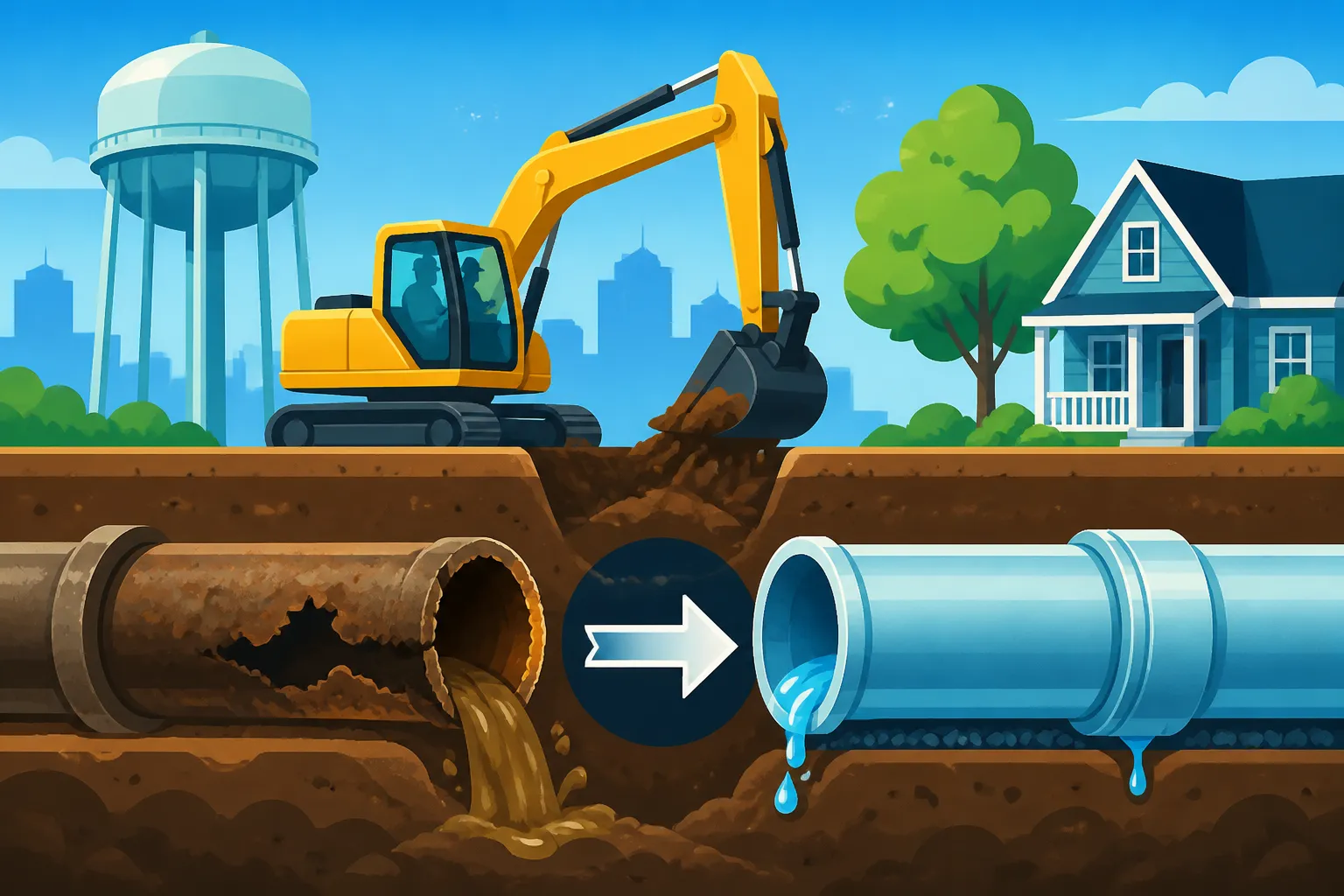
Replacing a buried service line generally requires locating the connection and accessing the pipe. That can mean excavation or another approved construction method, followed by installation work and restoration of affected surfaces. The exact method and the amount of digging can vary with site conditions and the work plan. The City’s project-status statements do not describe the construction method used at every property, so it would be misleading to assume every household saw the same process.
Nor does the word “replacement” tell you the precise boundary of the work. It is reasonable to ask whether the record describes the line from the water main to the building, only a section of it, or another defined portion. The work order or completion record is the place to look for that detail. If the document is unclear, ask the City to explain the scope rather than trying to infer it from a photograph of a trench or a repaired lawn.
A completed job can also involve more than the pipe itself. The work area may need to be opened and then restored, and the property owner may want to know what was disturbed and what follow-up was done. The nature of restoration depends on what was affected. A general statement that a line was replaced does not guarantee that every yard, sidewalk, driveway, or interior surface was handled in the same way.
The most useful questions are specific to the address and the record:
- Which service line or line segment does the record cover?
- What material was recorded before the work?
- What work does the completion record say was performed?
- Does the record indicate that the full connection was addressed or only a portion?
- Is there documentation about the material installed or left in place?
- Were any indoor plumbing changes included, or was the work limited to the buried service line?
- What restoration or follow-up work was recorded?
- Is there an inspection, flushing, or sampling record associated with the job?
These are not assumptions about what the City did. They are prompts for understanding the documented scope. If you want to know what the workday itself may involve in a replacement program, What Happens the Day a Michigan Crew Swaps Your Lead Service Line describes the kinds of questions homeowners can raise before and after construction. For post-work household steps, see The First Weeks After a Pipe Swap: A Household Checklist.
A photo can be useful, but it is not a complete record. It may show that work took place at a location without showing the material of every section, the final connection, or what remains inside. Likewise, a patch in a lawn or pavement may show that the area was disturbed, but it does not independently establish whether a service line was replaced. Pair visual clues with written records.
If you rent or live in a multi-unit building, the relevant service connection may not be easy to identify from inside your unit. Ask the property owner or manager which address or building record applies and whether the work covered the connection serving the whole building. A record associated with one address may not answer questions about every unit’s interior plumbing.
What may remain after a service line is replaced
The replacement of a buried lead service line does not automatically settle every question about lead in a home’s water plumbing. Pipes, fittings, solder, faucets, and other fixtures can be separate sources of lead. The amount of lead that may enter water can depend on the materials present and conditions within the plumbing. A replaced line is therefore one important piece of information, not a guarantee about the water at every tap.
Indoor plumbing deserves particular attention when a home is older, has undergone partial repairs, or has a history that is not well documented. Different sections may have been installed or changed at different times. A homeowner might know that the service line was replaced but not know what materials remain between the point where the line enters the building and the kitchen or bathroom fixtures.
The same caution applies to a replacement that addressed only a portion of the service line. If a record says the line was replaced, ask what “line” means in that record. Does it refer to the full connection or a defined section? Does the documentation identify the material of the remaining section? These details matter because “replacement” can sound more comprehensive than the written scope actually is.
Do not assume that clear, normal-tasting water proves that plumbing is free of lead. Lead cannot be confirmed or ruled out by taste, smell, or color. If the concern is the actual water at a tap, testing and pipe-material records answer different questions: an inspection can help identify materials, while a properly collected water sample can show what was present in that sample under the conditions when it was taken. For an overview of those distinctions, see Does Your City’s Water Report Show What Comes Out of Your Own Tap?.
A system-wide water quality report also has a different purpose from a household plumbing assessment. It describes monitoring for the water system, not necessarily the condition of each individual building’s plumbing. That difference is one reason a project completion announcement cannot serve as a personal water test. Michigan Water Quality Reports: A Resident’s Guide to the CCR explains how to use a utility report alongside information about your own home.
If you are concerned about lead exposure or health effects, contact your local health department or a medical professional. For questions about a particular sample or pipe, use a qualified testing laboratory or plumbing professional as appropriate. A filter should not be treated as a substitute for confirming what is in the plumbing; if you consider one, check that its certification and stated reduction claims match your test results and intended use. Lead-Reducing Filters in Michigan: When, Where and How to Use Them discusses how to evaluate that option.
The practical takeaway is to keep the questions separate: Was the service line replaced? What material remains in the building’s plumbing? What does a tap sample show? What steps, if any, are recommended for this household? A clear answer to one does not automatically answer the others.
How residents can verify work at an address
If you want to know whether a particular property was included, begin with the City’s address-specific records rather than a general announcement. The City of Flint’s official website is the place to find current information and contact details. Ask what records are available for the property and what each status means. If the record is incomplete or difficult to interpret, request clarification about the line segments and materials it covers.
When making that request, have the property address and any project notice, work order, or prior communication available. Ask for the final record of work, not only a general progress statement. A useful record should help distinguish whether a line was inspected, classified, replaced, or left unresolved. If there is no record, ask whether the City can explain how the address was categorized and what residents should do next.
You can also check whether your address appears on any available line inventory or map. A map is a starting point, not necessarily the final word. The entry may be based on records or inspection results, and a status such as unknown may mean the material has not been confirmed. It is worth asking when and how the classification was made and whether later construction changed the record. How to Check Whether Your Block’s Lead Lines Were Replaced offers a useful approach to looking for neighborhood-level information without treating it as proof about your own property.
If you are buying or selling a home, request the service-line documentation as part of the property records. Ask the seller for any City notices, completion paperwork, invoices, or inspection results related to the connection. If the paperwork says that a line was replaced but does not describe the scope, ask for clarification before relying on the statement. Buying a Michigan Home With City Water: Questions Before Closing and Selling a Michigan Home With a Lead or Unknown Service Line cover related questions to raise during a transaction.
For renters, ask the landlord or property manager for any available information about the building’s service line and plumbing. A tenant may not control access to buried pipes or building records, but can ask whether the owner has received a City notice or has documentation from completed work. If a health concern or a possible lead exposure issue arises, speak with the local health department or a medical professional.
A practical verification sequence is:
- Gather the address and any project-related paperwork.
- Check the City’s official information for the address or line status.
- Ask for the record that describes completed work, including the line segments covered.
- Clarify any unknown, partial, or ambiguous status directly with the City.
- Keep the record with household or property documents.
- Consider separate plumbing inspection or water testing if the remaining indoor plumbing or tap water is still a concern.
This process helps prevent a common misunderstanding: assuming a citywide project announcement is a complete record for one home. The City’s reported completion and the final line identified through the federal settlement agreement establish the project’s stated status, while address-level records are needed to understand a specific property.
Frequently Asked Questions
Did Flint replace every pipe in every home?
The City describes the work as a lead service line replacement project. That does not establish that all indoor plumbing, fixtures, water mains, or every other pipe at every property was replaced. Check address-specific records for the scope of the work.
Does a completed service-line replacement prove the tap water contains no lead?
No. A service-line record concerns the buried connection, while water at a tap can also be affected by plumbing inside the building. A household water sample and information about indoor plumbing address different questions.
What does Over 97% mean for a particular address?
According to the City of Flint, Over 97% of replacements have been completed. That project-wide progress statement does not confirm what happened at an individual property. Ask the City for the address-specific record.
What should I do if there is no notice or the line is listed as unknown?
Check the City’s official information and ask how the address was classified and whether additional records or inspection are available. For more on this situation, see Service Line Marked Unknown, or No Notice Came? Next Steps in Michigan.
Sources
- City of Flint — Progress Report on Flint Water – City of Flint (checked November 13, 2026)
- City of Flint — Water & Utilities Archives – City of Flint (checked November 13, 2026)
Disclaimer
This article is for general informational purposes only and does not constitute professional advice. Laws, prices and regulations vary by location and change over time. Consult a qualified professional for guidance on your specific situation. Michigan Water Guide is not a government agency or water utility and is not affiliated with any public water system.