Who Supplies Flint’s Drinking Water Now, and What Changed?
If you live in Flint or are trying to understand its water after the city’s crisis, the supplier can be confusing: a regional authority provides the water, while local pipes and household plumbing still affect what comes out of a tap. Here’s how the current arrangement works, what changed, and what the city’s water-quality report can—and cannot—tell you.
Who supplies Flint’s drinking water now?
The Great Lakes Water Authority supplies Flint under a wholesale water contract. The City of Flint’s role is different: it manages the local system that carries water through the city and to customers. So the practical answer is that the authority supplies the water, while the city remains an important point of contact for local service, water-quality information and distribution-system questions.
According to the City of Flint, the city has a 30-year contract agreement with the Great Lakes Water Authority. That contract describes the ongoing relationship between a regional supplier and the city, rather than a transfer of every water-system responsibility to the authority.
This distinction matters when you need help. A question about the regional supply is not necessarily the same as a question about a water main, a local service line, a home’s plumbing or a billing account. For an overview of how oversight and utility responsibilities fit together, see Who Oversees Michigan Tap Water? Agencies and Utilities Explained. For the regional supplier’s role, Wholesale Water: When a Town Buys From a Bigger Supplier explains how a community can buy water from a larger provider while still operating its own local system.
Supplier, distributor and homeowner plumbing
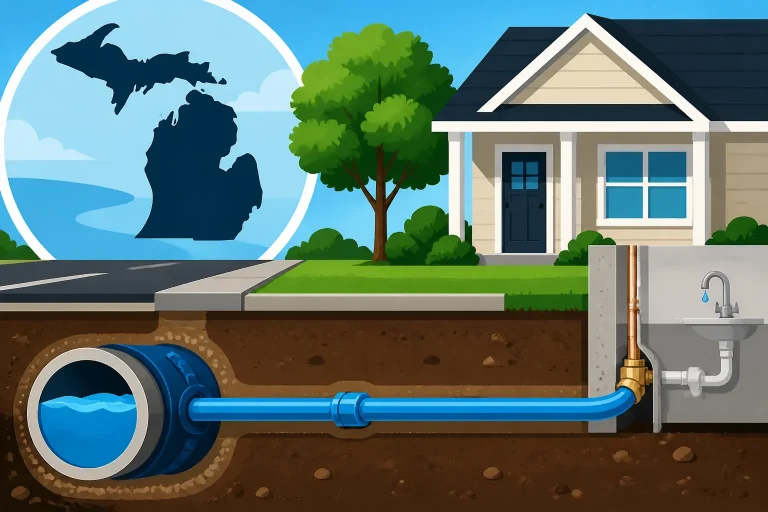
A wholesale supplier provides water to a community’s system. The local utility then manages the water network within its service area. After water reaches a property, the service line and indoor plumbing become part of the path to a particular faucet. The responsibilities for those parts can differ, so it is useful to identify which part of the system your question concerns before contacting anyone.
For example:
- A question about the regional supply or treatment results may be answered by the supplier’s information or the city’s water-quality report.
- A question about a local main, a service interruption or a city notice is more directly about the local system.
- A question about a home’s service line, faucet, solder or galvanized plumbing may require property-specific information.
- A billing question belongs with the organization that issues the account, which may not be the same organization that treats or wholesales the water.
The distinctions can sound technical, but they help avoid a common frustration: being sent to the wrong office because “the water company” could mean more than one organization. Who Answers for Water Safety in Michigan: Utility or Homeowner? offers more detail about where public-system responsibilities end and household plumbing concerns begin.
What changed in Flint’s water arrangement?
The current setup is based on a regional supply relationship with the Great Lakes Water Authority, rather than the arrangement Flint relied on during the water crisis. The change is not just a new name on a bill: the source and delivery arrangements, the city’s connection to the regional system and the responsibilities of local operators all matter.
According to the City of Flint, Flint’s connection to a secondary water line was completed in Spring 2022. The city’s description of that connection is important because it explains a change in the physical delivery arrangement, not a guarantee about every pipe between the system and an individual tap.
A secondary connection can give a water system another route for receiving water, which may offer operational flexibility. But a second route does not by itself tell a resident whether the plumbing inside a particular home contains lead, whether a service line has been replaced, or whether the water at a specific tap has been tested. Those are separate questions that depend on the local network and the property.
It also helps to separate the supplier from the source. The Great Lakes Water Authority is the contractual supplier named in the City of Flint’s agreement. The city’s water-quality report also discusses results at the Lake Huron plant. Those details describe different parts of the supply chain: who supplies Flint under contract, and where certain treatment results in the report were measured.
For a broader explanation of how water travels from its source to a Michigan faucet, see Where Michigan Tap Water Comes From: Lakes, Rivers and Groundwater. Residents looking for a more focused account of Flint’s current setup can also read Flint Tap Water Now: A Practical Guide for Residents and Newcomers.
A regional supply does not erase local variation
Water from a regional supplier still passes through local infrastructure before it reaches a home. The condition and material of a service line, building plumbing and fixtures can all affect what a resident needs to investigate. That is why a good systemwide report is useful but does not replace information about a particular address.
A home with older plumbing may raise different questions than a newly built property. An apartment resident may need to ask the landlord or building manager about internal plumbing and any building-specific testing. A homeowner may need to check the status of the service line on both the utility side and the private side. If you are unsure which segment is which, Utility Side vs. Private Side: Does Michigan Replacement Cover Both? explains the distinction.
Flint residents can also look for address-specific service-line information rather than assume that a citywide improvement applies equally to every property. How to Check Whether Your Block’s Lead Lines Were Replaced and Service Line Marked Unknown, or No Notice Came? Next Steps in Michigan cover practical ways to follow up when a line’s material or replacement status is unclear.
What does the city’s water-quality report say?
A water-quality report summarizes system monitoring and results for a reporting period. It can help residents understand the water supplied and treated by the system, including whether reported measurements met applicable limits. It cannot show exactly what happened in every home’s plumbing or establish the condition of every individual tap.
The City of Flint’s 2025 report lists these results for water at the Lake Huron plant:
| Measure in the report | Reported result | Comparison stated in the report |
|---|---|---|
| Filtered water turbidity | Highest result of 0.14 NTU | Limit of 1 NTU; no violation |
| Total chlorine | Highest level of 1.02 ppm | MRDL of 4.0 ppm; no violation |
Turbidity is a measure related to the cloudiness of water. Chlorine is used in water treatment, and a reported chlorine level is not the same thing as a result for lead or another contaminant. The report’s results are useful for understanding these specific measurements at the plant; they should not be treated as a test of a particular kitchen faucet.
The report’s finding of no violation for those listed results is also not a statement that every home has the same plumbing or that every possible water-quality concern has been ruled out. A plant measurement and a household sample answer different questions. If your concern is lead from a service line or interior plumbing, read Does Your City’s Water Report Show What Comes Out of Your Own Tap? and How to Tell Whether Your Michigan Service Line Is Lead.
How to read the reported values
A table in a consumer confidence report can be hard to interpret if you are not sure what the measure represents. Start by looking at the name of the measurement, the unit, the reported result and the comparison value. Then check whether the report says there was a violation. These details are more meaningful together than a result taken out of context.
For example, the turbidity result is reported in NTU, while chlorine is reported in ppm. Those units describe different measurements and should not be compared directly. Likewise, a reported maximum or highest result is not necessarily the same as the level at every point in the system or at every moment.
If a result looks confusing, check how the report defines the measure and whether it describes the sample location. Michigan Water Quality Reports: A Resident’s Guide to the CCR explains how to work through the different sections. MCLs, Action Levels and Units: Reading a Michigan Water Report Table can help when a report uses limits, action levels or technical units.
What should Flint residents check at home?
Start with the question you are trying to answer. If you want to know who supplies the water, the contract and city information identify the Great Lakes Water Authority as Flint’s supplier. If you want to know how the water performed at the treatment plant, the city’s report provides system monitoring results. If you want to know whether your own tap has a particular issue, you may need address-specific records or a sample collected from your home.
These are related but not interchangeable checks. A city report does not identify the material of every service line, and a service-line inventory does not measure what is coming from every faucet. A test taken at a home gives information about the sample collected under the test’s conditions; it does not automatically establish that all taps or all homes have the same result.
If your concern is lead plumbing
Check the service-line information for your property, and ask whether the line is confirmed, unknown, lead, or another material. Keep in mind that a replaced public-side line does not necessarily mean the private-side line or indoor plumbing has also been replaced. For a deeper explanation of remaining lead risks after pipe work, see Lead After Line Replacement: What Can Linger in Michigan Home Plumbing.
The City of Flint’s 2025 report says people with a lead service line or a galvanized, requiring replacement service line may need to flush for at least 5 minutes. Follow the report’s directions for the circumstances it describes, and confirm current guidance with the City of Flint if you are not sure what applies to your property. Flushing guidance is not a substitute for confirming the service-line material or testing when testing is appropriate.
Residents who want to understand the sampling process can read How Michigan Cities Sample Tap Water, and How Results Vary by Home. For testing options and how to match a test to a concern, How to Test Your Water in Michigan: Labs, Sample Kits and Costs is a useful next step. If the question is specifically about lead, How to Get Michigan Tap Water Tested for Lead, Step by Step explains what to ask and what a sample can tell you.
If you rent or live in a multi-unit building
Ask the landlord or building manager who supplies the property’s water and whether the building has information about service-line materials, indoor plumbing or recent sampling. The building may be connected to the city system, but plumbing inside the building can still affect what reaches an individual unit.
A renter can also ask whether the unit’s tap has been included in any testing and how the sample was collected. If a building representative provides a report, check its date, sample location and scope rather than assuming that a result from another unit applies to yours. Renting in Michigan: How to Look Up Your Building’s Water Quality discusses how to ask about a rental’s supply and records.
If the water’s taste, smell or appearance changes
A change in taste, smell or color does not identify its cause on its own. It may be related to plumbing, work on the distribution system, a fixture or another issue. Check for a notice from the City of Flint and contact the official utility if the change is persistent or concerning. Avoid relying on appearance or taste as a way to confirm that water is free of contaminants. For help thinking through common changes, see Taste, Smell and Color: A Guide to Odd Tap Water in Michigan Cities.
If you have a health concern about water, ask your local health department or a medical professional. For current utility contact details or notices, use the City of Flint’s official website.
How to confirm what applies to your address
A clear way to investigate is to keep separate notes on the supplier, the local system, the service line and the household tap. This makes it easier to ask a focused question and understand which record or test could answer it.
- Confirm the supplier. Use City of Flint information to verify the current wholesale arrangement and how the city describes its connection to the regional system.
- Read the current report. Find the City of Flint’s consumer confidence report and check its reporting period, sample locations, results and explanations. How to Find Your Michigan Water Supplier’s Consumer Confidence Report explains where to start.
- Check local notices. Look for current advisories or service updates from the City of Flint rather than relying on old posts or reports.
- Ask about your property’s service line. Request the material classification and whether it is confirmed or unknown. If the response is unclear, ask what records or inspection could resolve it.
- Match testing to the concern. A general water test, a lead test and a systemwide report do not answer identical questions. Choose a test based on the specific concern and follow the laboratory’s sample instructions.
- Keep records together. Save reports, letters, test results and notes from conversations. Record the sample location and collection date so you can tell which result applies to which tap and situation.
For questions about a bill, verify the account and charges with the organization listed on the bill; the supplier and billing contact may not be the same. Understanding a Michigan Water Bill: Charges, Shutoffs and Help explains how to read common bill components. For questions about whether Flint’s current supply is safe for your particular household, Is Flint, Michigan Water Safe to Drink, or Should You Still Filter? discusses why the answer depends on system information and property-specific details.
The central takeaway is straightforward: the Great Lakes Water Authority supplies Flint under a long-term agreement, while the City of Flint remains important for local distribution, notices and resident information. The regional connection and plant results help explain the public system, but they do not reveal the condition of every service line or indoor plumbing. For a household-specific concern, check the property records and use testing or professional guidance that matches the question.
Frequently Asked Questions
Who is Flint’s water supplier?
The Great Lakes Water Authority supplies Flint under a contract with the City of Flint. The city remains relevant for local distribution information, notices and resident questions.
What changed when the secondary water line was completed?
The connection added a secondary route to the city’s supply arrangement. The City of Flint says the connection was completed in Spring 2022. The connection does not establish the condition of an individual home’s pipes.
Do the Lake Huron plant results prove my tap is lead-free?
No. The results in the city’s report describe measurements at the plant. They do not identify the material of your service line or test the water from your faucet.
How long may some residents need to flush?
The City of Flint’s 2025 report says people with a lead service line or a galvanized, requiring replacement service line may need to flush for at least 5 minutes. Check the report and the city’s current guidance to see what applies to your property.
Sources
- City of Flint — Progress Report on Flint Water – City of Flint (checked November 13, 2026)
- City of Flint — Annual Water Quality Report 2025 (PDF) (checked November 13, 2026)
Disclaimer
This article is for general informational purposes only and does not constitute professional advice. Laws, prices and regulations vary by location and change over time. Consult a qualified professional for guidance on your specific situation. Michigan Water Guide is not a government agency or water utility and is not affiliated with any public water system.