Flint Tap Water Now: A Practical Guide for Residents and Newcomers
If you live in Flint or are moving there, it can be hard to separate current water information from memories of the crisis. The useful starting point is to check what the latest report says, understand what it cannot tell you about your own plumbing, and confirm whether your service line is known. This guide explains those steps and what to do next.
What changed in Flint’s water supply
Flint’s water history matters, but it should not be confused with the water arrangement residents have now. The city’s supply, its treatment and monitoring, and the pipes that carry water to an individual home are related parts of one system—but they answer different questions.
According to the City of Flint, the city’s connection to a secondary water line was completed in Spring 2022. The City of Flint also has a 30-year contract agreement with the Great Lakes Water Authority. These details describe the supply arrangement; they do not, by themselves, establish the condition of every pipe between a water main and a kitchen faucet.
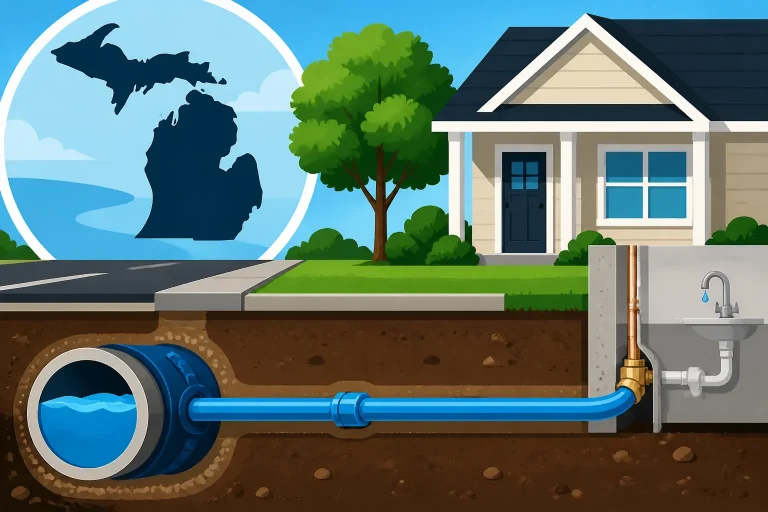
That distinction is important. A community water supplier treats water and monitors the public system. Water then moves through distribution infrastructure and a service line before reaching a building’s plumbing. Pipes, faucets, solder, and fixtures inside a home may be older or made of different materials than the public water main. As a result, the water leaving a treatment plant and the water collected at one particular tap are not automatically identical in every respect.
For background on the system and its history, see Who Supplies Flint’s Drinking Water Now, and What Changed?. For a broader look at how sources, treatment, and distribution connect, Where Michigan Tap Water Comes From: Lakes, Rivers and Groundwater offers useful context.
A current supply arrangement is reassuring information about where water comes from, but it is not a substitute for checking the latest water-quality report or the line serving a particular property. Likewise, knowing a property has a service line that is not lead does not answer every question about older interior plumbing. Each piece of information has a defined scope.
It can help to think of the questions in layers:
- Where does the community’s water come from? Check the city’s current supply information.
- How did the water perform in monitoring? Read the current Consumer Confidence Report, often called a water quality report.
- What material is the service line? Check the city’s service line inventory or ask the city to confirm the address-specific record.
- What might be happening inside the home? Consider the building’s plumbing history, the specific faucet, and whether a suitable water test is warranted.
A positive answer to one question does not settle all the others. A report can describe system-wide monitoring without diagnosing one home’s plumbing. A service line inventory can identify a buried pipe without describing a faucet or fixture. A water test can provide information about a particular sample, but it does not reveal every pipe material.
How to read Flint’s water-quality report
A Consumer Confidence Report (CCR) is the practical place to start when you want to know what a community water system reports about water quality. It summarizes monitoring results and explains whether the system met applicable requirements for the reporting period. It is not a test of the water at every tap, and it is not a guarantee that all household plumbing is free of lead or other concerns.
According to the City of Flint’s 2025 report, filtered water at the Lake Huron plant had a highest turbidity result of 0.14 NTU against a limit of 1 NTU, with no violation. According to the same City of Flint report, total chlorine at the Lake Huron plant had a highest level of 1.02 ppm against an MRDL of 4.0 ppm, with no violation.
Those figures describe particular monitoring results at the Lake Huron plant. Turbidity relates to the cloudiness of water, while chlorine is used in water treatment and distribution. A result below a stated limit, and a report of no violation for that measure, should be read as a finding about that measure and the monitoring described—not as a result for every home’s faucet or a test of every possible contaminant.
When you open a report, look for the reporting period first. Then find the table that lists contaminants or water-quality measures, the result, the applicable limit or standard, and whether a violation was reported. Definitions matter: a maximum contaminant level, an action level, a treatment technique, and a secondary standard do not all mean the same thing. If a table or abbreviation is confusing, MCLs, Action Levels and Units: Reading a Michigan Water Report Table can help explain how to approach it.
It is also useful to check what a report does not show. A community report does not usually identify the plumbing materials at an individual address. Nor does a citywide monitoring result necessarily describe the water after it has sat in a home’s pipes. That gap is why a report and an address-specific service line record are complementary rather than interchangeable.
For a step-by-step approach to locating the report and checking its reporting period, use How to Find Your Michigan Water Supplier’s Consumer Confidence Report. If you have the report but are unsure how to connect its system-wide findings to your own faucet, Does Your City’s Water Report Show What Comes Out of Your Own Tap? explains the distinction.
Be careful with broad conclusions. “No violation” in a report is meaningful for the monitored result and reporting context, but it does not prove that an individual home has no lead source. Likewise, an unusual taste, odor, or color does not automatically prove that water is unsafe or that a particular contaminant is present. A symptom can have more than one possible cause, and some water concerns cannot be identified by appearance or taste.
If a table appears to show a violation, read the accompanying explanation and follow the instructions the City of Flint provides. If you cannot tell what the result means for a specific household, ask the utility for clarification. For questions about possible health effects, contact the local health department or a medical professional rather than relying on taste, a general report, or an online interpretation.
Check the service line and the home’s plumbing
The service line is the pipe that carries water between a water main and a building. Depending on the property and local system design, responsibility for portions of that connection may be divided between the public side and the property side. A line may also have more than one material along its length, so a record or inspection needs to account for what is actually present.
Start with the City of Flint’s address-specific service line information. Look for the material classification and whether the record is confirmed or uncertain. If the city’s record is missing, unclear, or marked unknown, ask the city what that status means and what inspection or follow-up is available. Do not assume that a blank record means a line is safe, or that a record for one section describes the entire path to the building.
For help interpreting common material categories and inventories, see How to Tell Whether Your Michigan Service Line Is Lead and Service Line Marked Unknown, or No Notice Came? Next Steps in Michigan. The distinction between the public side and the privately owned side is covered in Utility Side vs. Private Side: Does Michigan Replacement Cover Both?.
A service line is only part of the picture. Older indoor plumbing can include lead-containing components, such as some solder, fixtures, or galvanized pipe that was previously connected to lead. The condition and materials may differ from one home to another, including within a multi-unit building. A property’s age can be a reason to ask questions, but it is not a substitute for verifying materials.
If you are renting, ask the landlord or property manager what is known about the service line and the building’s plumbing, and whether the utility has provided any relevant notices or instructions. A renter may not control the buried line or building-wide plumbing, but can still request information and ask who handles utility questions. Renting in Michigan: How to Look Up Your Building’s Water Quality has more on finding out who supplies a rental building.
If you are buying a home, request the service line record and any documentation of inspection or replacement. Clarify whether work covered the entire service line or only a section, and whether indoor plumbing was included. These details matter because a replacement of a buried line does not automatically mean that every older pipe, faucet, or plumbing connection inside the home was replaced. For buyer-specific questions, see What Home Buyers Should Ask About an Unverified Michigan Service Line.
If a line was replaced, ask what work was done and whether the contractor or utility gave instructions for cleaning plumbing fixtures or flushing the home plumbing afterward. Keep written records of the work and any follow-up advice. If a notice or letter refers to a service line classification you do not recognize, ask the city to explain the classification and what action, if any, is recommended for that address.
A water sample and a pipe inspection answer different questions. A sample can measure what is present in the collected water under the conditions of collection. It does not identify all pipe materials. An inspection or inventory can identify materials, but it does not establish the amount of a contaminant in water at a particular tap. If the concern is lead in the water, learn what kind of sample is appropriate and how it should be collected. How to Get Michigan Tap Water Tested for Lead, Step by Step explains the testing process.
Everyday use, flushing, and filters
Follow current City of Flint instructions for your address and situation. Advice can differ depending on whether a line is confirmed, whether work has recently taken place, and what the current notice says. Do not apply a flushing instruction meant for one category of service line to every home without checking whether it applies to yours.
According to the City of Flint’s 2025 report, people with a lead service line or a galvanized, requiring replacement service line may need to flush for at least 5 minutes. The report’s wording matters: this instruction is tied to those service line categories. Residents should check the report and any current address-specific notice to confirm whether the guidance applies to their home and whether the city has issued updated directions.
Flushing is not a substitute for confirming the pipe material or following any notice. If water has been stagnant in plumbing, the city may provide specific directions for bringing fresh water through the line. Follow those directions as written, including any cautions about the tap to use or the amount of time. If you are unsure whether your address falls within the category described in the report, contact the City of Flint through its official website to find current information and contact details.
A filter can be useful when it is selected for a clearly defined concern, but it does not replace a service line record, a water test, or the utility’s instructions. Check the filter’s certification and the specific reduction claim against the concern you are trying to address. A product designed to reduce one substance may not reduce another, and performance depends on proper installation, use, and timely cartridge replacement. A filter should never be described as preventing or treating a disease.
For lead concerns, use a filter specifically certified to reduce lead, and follow its instructions for installation, flow, and cartridge replacement. A filter’s presence alone is not proof that the water has been tested or that the plumbing issue has been resolved. Lead-Reducing Filters in Michigan: When, Where and How to Use Them covers selection and use, while Using a Lead Filter Correctly: Flow, Cartridges and Cold Water explains why following the product directions matters.
If the concern is taste or chlorine, the right treatment approach may be different from a lead-reduction filter. If the concern is an unverified service line, a filter may be a temporary precaution only if it is suited to the specific concern; it does not tell you what the buried line is made of. Should You Filter Michigan Tap Water? The Reasons Residents Give is a useful overview of how to weigh that decision.
Avoid making a treatment choice solely because of a sales pitch, a general claim on packaging, or water appearance. Start with the concern, check the utility information or test result, and verify that the product’s certification matches the specific reduction you need. If you have a test result, use the units and conditions on that report when comparing options. For treatment choices after testing, see Choosing a Michigan Water Treatment System After You Test, Not Before.
Water that looks clear can still require attention to plumbing or a test result, and discolored water can have causes unrelated to lead. If water’s appearance, smell, or taste changes suddenly, check for a city notice and contact the City of Flint for current guidance. Do not use a home filter as a way to determine whether a change is safe. Taste, Smell and Color: A Guide to Odd Tap Water in Michigan Cities offers a practical way to think about water changes without treating a sensory clue as a lab result.
What to do if you have a concern
A practical response starts with a specific question. “Is my home’s service line lead, galvanized, or unknown?” calls for an address-specific record or inspection. “What does the latest city report say?” calls for the current CCR. “Is lead present at this faucet?” calls for an appropriate water sample and careful collection. Treating these as separate questions helps avoid paying for an unsuitable test or buying a filter before you know what it is meant to address.
Use this sequence:
- Check for a current city notice. Look at the City of Flint’s official website for service updates or instructions relevant to your address. If there is an active notice, follow it rather than relying on older advice.
- Read the latest water-quality report. Confirm the reporting period and review the result, limit, and violation information for the specific measure you are concerned about.
- Check the service line record. Find the classification for your address and ask the City of Flint what to do if the record is missing or uncertain.
- Ask about indoor plumbing. If the building is older, has had plumbing work, or has an unknown history, ask the owner, landlord, or a qualified plumber what materials are known to be present.
- Decide whether testing fits the question. Choose a sample type and collection method appropriate to the concern. A sample collected from one tap under one set of conditions may not answer every plumbing question.
- Use treatment only when it matches the evidence. Check certification and follow installation and maintenance directions. Keep the report or test result that led to the decision, and reassess if the plumbing or water conditions change.
If you are concerned about lead, avoid assuming that a single general system result settles what is happening at your tap. A utility’s monitoring and a home sample have different purposes. Ask the City of Flint whether it offers guidance or sampling options for your situation, and confirm the collection requirements before collecting a sample. Asking Your Water Supplier for a Lead Sample: How Michigan Homes Do may help you prepare questions.
When a test is appropriate, use a qualified laboratory or a sampling program designed for the contaminant and question involved. Collection details can affect the result. A sample taken after flushing may answer a different question from one taken after water has sat in plumbing. Follow the instructions from the laboratory or utility rather than improvising a collection method. How to Test Your Water in Michigan: Labs, Sample Kits and Costs explains how to match a test to a concern.
If you receive a result you do not understand, check the units, the sample location, the collection conditions, and what comparison value the report uses. A detection is not the same as a violation, and a result below a limit does not necessarily describe every tap or every future condition. For help interpreting the report, ask the lab, utility, local health department, or a qualified water professional, depending on the question. If you are asking about possible health effects, contact the local health department or a medical professional.
For a change in taste, smell, or color, first determine whether it is limited to one faucet, one part of the home, or every tap. Check whether hot water differs from cold and whether a city notice has been issued. Those observations can help narrow down what to ask, but they do not confirm a contaminant. Do not drink water you have been told not to use, and follow any specific public notice.
New residents can make the process easier by saving a copy of the latest report, the property’s service line record, and any plumbing or replacement paperwork. Keep notes about whom you contacted and what instructions were provided. That way, questions can be revisited without relying on memory or an old listing description. For a wider checklist of what to look up after moving, see New to Michigan? A Checklist for Getting to Know Your Tap Water.
A practical checklist for Flint residents and newcomers
The most useful approach is neither to assume that every concern is resolved nor to treat every uncertainty as proof of a problem. Use current, address-specific information wherever possible. The city’s water report is a starting point for system-level monitoring; the service line record is a starting point for buried pipe materials; and a properly selected test can address a specific question about sampled water.
Keep these distinctions in mind:
| Information | What it can help answer | What it cannot establish on its own |
|---|---|---|
| Current water-quality report | What the system reported for the stated monitoring period | The condition of every home’s plumbing or every individual tap |
| Service line inventory | The recorded material or status of a buried service line | The material of every indoor pipe, faucet, or fixture |
| Water test | What was measured in the particular sample collected | The material of the plumbing or conditions at every other tap |
| Filter certification | Whether a product is certified for a stated reduction claim | Whether the home has a particular contaminant or whether the filter is maintained correctly |
| Taste, smell, or color observation | Whether water seems different and where the change occurs | The identity or amount of a contaminant |
When you are unsure what a record means, ask for the missing detail rather than filling in the gap yourself. For instance, if a service line record says unknown, ask what is needed to confirm the material. If a report lists a result you cannot interpret, ask what the result covers and whether it applies to the plant, distribution system, or a specific sample. If a filter is being recommended, ask which contaminant it is certified to reduce and what test or record supports that choice.
For a home purchase or rental, treat water information as part of the property’s practical history. Ask who supplies the building, whether the owner has current service line information, and whether plumbing work has been documented. In an apartment or condominium, also ask whether the building has shared plumbing or a building-level supply arrangement that changes whom to contact. If the answer is unclear, confirm the supplier with the City of Flint rather than relying only on a listing, a neighbor’s account, or an old document.
For a household already in Flint, revisit the information when something material changes: a pipe replacement, a new service line notice, a change in building ownership, a new test result, or a water-quality notice. Keep instructions that relate to the property rather than applying guidance from another address. A neighbor may have a different service line classification or different interior plumbing.
It is reasonable to want a direct answer about whether water is safe at a particular tap. The available evidence may not come from one source: the report, service line record, plumbing history, and an appropriately collected sample each contribute different information. When the evidence is incomplete, the next step is to identify what is missing and ask the responsible source—not to infer a result from taste or from a system-wide number alone.
Frequently Asked Questions
Does the 2025 report describe the water at my kitchen faucet?
No. The City of Flint’s report describes monitoring results for the system and the stated reporting period. It does not test every household faucet or account for the plumbing in each building. An address-specific concern may call for checking the service line record or arranging an appropriate sample.
Does a no-violation result mean my home has no lead plumbing?
No. A system monitoring result does not identify the material of your service line or indoor plumbing. Check the City of Flint’s service line information for your address and ask about plumbing records or an inspection if the material is uncertain.
What if my service line record says unknown?
Ask the City of Flint what the classification means for your address and what steps are available to confirm the material. Do not treat an unknown entry as confirmation that the line is lead or that it is not lead. The city’s current instructions are the relevant source for any follow-up.
Should I buy a filter before testing?
That depends on the concern. If you choose a filter, verify that its certification covers the specific reduction you need and follow the manufacturer’s instructions. A filter does not identify plumbing materials or replace a test when a test is needed. Consider checking the service line and choosing any treatment based on a defined concern or result.
Sources
- City of Flint — Progress Report on Flint Water – City of Flint (checked November 13, 2026)
- City of Flint — Annual Water Quality Report 2025 (PDF) (checked November 13, 2026)
Disclaimer
This article is for general informational purposes only and does not constitute professional advice. Laws, prices and regulations vary by location and change over time. Consult a qualified professional for guidance on your specific situation. Michigan Water Guide is not a government agency or water utility and is not affiliated with any public water system.