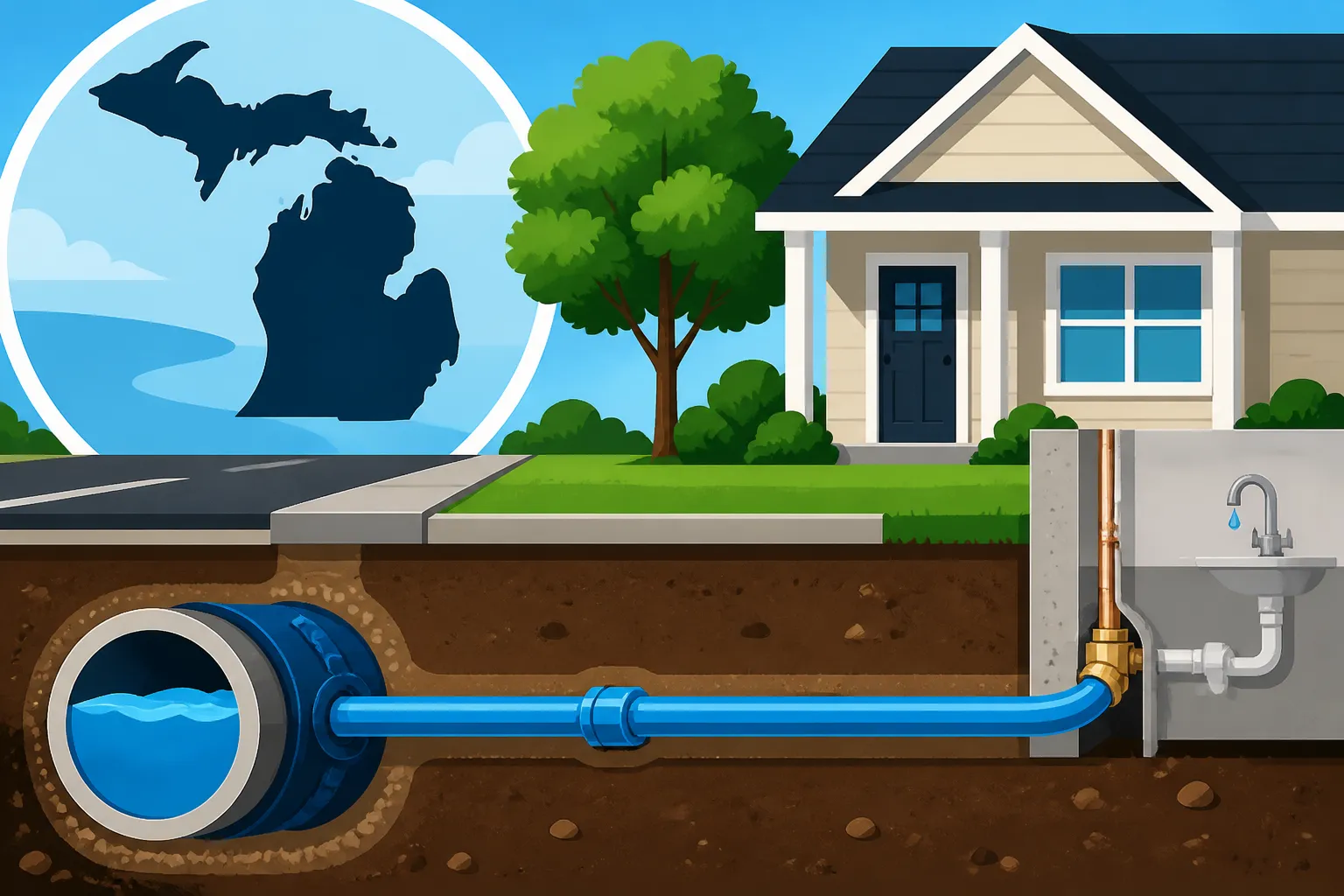
Michigan Service-Line Replacement Coverage From Street to Home
Michigan service-line replacement coverage can be confusing because the pipe from the water main to a home may cross public and private property, and different parts may have different owners. The practical starting point is to confirm what material serves your address, where the utility’s work ends, and what the replacement plan actually includes.
Trace the service line from the water main to the home
A service line is the pipe that connects a water main to a building. It runs from the public water system toward the home, but the route can cross property boundaries. That is why a replacement described as “complete” may not mean every pipe carrying water inside the building has also been replaced.
The route is easier to understand when you separate its parts:
- Water main: The larger public pipe in the street that supplies nearby properties.
- Connection to the main: The point where the service line branches off the water main.
- Public-side portion: The segment on public property or otherwise assigned to the water provider, depending on local rules and the property arrangement.
- Private-side portion: The segment on private property that may be assigned to the property owner.
- Building plumbing: Pipes inside the building, including pipes that may connect to fixtures after the service line enters the structure.
These are useful categories, not a guarantee that every Michigan community uses the same ownership boundary. A property line, curb, sidewalk, curb stop, or building wall may help locate a transition, but none should be assumed to mark the responsibility split without checking the utility’s records and program terms.
The term “service-line replacement” usually refers to work on the pipe connecting the main to the building. It does not automatically mean replacement of indoor plumbing, a water heater, faucets, or every pipe beneath the property. The work area and the material replaced should be confirmed in writing.
For a closer look at how the responsibility split can work, see Utility Side vs. Private Side: Does Michigan Replacement Cover Both?. The physical endpoint also matters: Where the Service Line Ends and Your Michigan Home Plumbing Begins explains why a service-line project and an indoor-plumbing project are not necessarily the same job.
| Part of the water route | What to establish | Why it matters |
|---|---|---|
| Water main connection | Whether the connection or fitting is included in the project | A line may be replaced while a connection detail is handled separately |
| Public-side service line | Who owns or maintains this segment | The utility may arrange work on this portion under its program |
| Private-side service line | Whether the homeowner’s segment is included or requires separate approval | Private property access and responsibility may affect the scope |
| Entry point at the building | Where the service line ends under the local definition | The line’s endpoint helps distinguish it from indoor plumbing |
| Indoor plumbing | Whether any pipes or fixtures inside the building are part of the project | A service-line replacement may leave interior components in place |
A useful mental model is to treat “coverage” as a question about the specific work authorized for a specific property. The word alone does not tell you which segments will be excavated, who will arrange the work, who pays, or what happens to landscaping afterward.
What replacement coverage may include—and what it may leave behind
Coverage is not one universal package. A utility or replacement program may have a defined scope, and that scope can depend on the material found, the property, the funding arrangement, access, and the terms the owner is asked to accept. Before treating a notice or conversation as confirmation, ask for the project boundary and the work description.
A replacement project may address some or all of the service line from the water main toward the building. Depending on the local program, work may involve excavation, removing or abandoning an old line, installing replacement pipe, connecting the new line, and restoring disturbed surfaces. These are possible project elements, not a promise that every program includes each one.
The private-side segment is often the part residents most need to clarify. A utility may replace its portion while the owner’s portion remains unchanged, or a local program may offer a way to replace the line across the property boundary. A project may also require the owner to grant access or sign an agreement before work can proceed. Ask the provider which condition applies at your address rather than inferring it from a neighbor’s work.
Even when a program replaces the full service line, indoor plumbing can remain. A line may enter the home and connect to older plumbing, fittings, or fixtures that are outside the project scope. A new service line therefore does not establish that every water-contact surface in the home has been replaced.
There can also be practical limits to what a project restores. The crew may disturb a lawn, garden, driveway edge, walkway, or other surface while reaching the pipe. The restoration method, timing, and responsibility for damage should be discussed before work begins. Do not assume “replacement” covers every improvement or repair on the property.
Ask for clear answers to these questions:
- Which exact pipe segments will be replaced?
- Where does the project begin, and where does it end?
- Does the work include the public-side and private-side portions?
- Will the connection at the main or the entry into the building be changed?
- Are indoor pipes, fixtures, or the water heater part of the work?
- What surfaces may be excavated, and what restoration is included?
- Does the project require permission to enter the property?
- Is there any owner cost, and what circumstances could change it?
- What happens if the crew finds a different pipe material than expected?
- What written record will confirm the materials and work completed?
The answers should be specific enough that a resident can tell what will physically change. If the response uses broad terms such as “the line” or “full replacement,” ask the provider to identify the start and end points on a diagram or property sketch. If there are separate agreements for access, payment, or restoration, read each one before signing.
A replacement may also leave other sources of lead in place. Older building plumbing, solder, fittings, or fixtures can remain even when the service line is replaced. The distinction is important because a successful service-line project addresses the service line, not every possible component between the building’s entry point and a glass of water. See Faucets, Solder and Galvanized Pipe: Indoor Lead Sources Left Behind for more on that distinction.
Confirm the pipe material and the status of your address
Before making decisions about replacement, find out what the records actually say about your service line. A record that says “lead,” “galvanized,” “unknown,” “assumed,” or “verified” does not mean the same thing. Ask how the material was determined and whether the information applies to the entire line or only one segment.
Start with the water provider that serves the address. A city name alone may not be enough to identify the provider, particularly where water is purchased from another system or a building has a distinct arrangement. If you are unsure who serves the property, Which Utility Serves This Address? A Water Lookup Guide can help you identify where to direct the question.
Then compare the provider’s record with the information available at the property. Useful clues may include past service-line notices, inspection records, plumbing work receipts, drawings, or records from a previous owner. Those clues can help frame a question, but they do not necessarily verify the material of the full line. A plumber’s observation inside the home, for example, may show where a pipe enters the building without establishing what material runs beneath the yard or street.
For Detroit addresses, the City of Detroit provides an interactive Water Service Line Inventory Map. The City says residents and businesses can use the map to see whether a property’s service-line material is listed as verified or assumed. A status marked assumed should not be treated as the same thing as a physical confirmation. If the record is unclear or does not match what you know about the property, ask the City of Detroit how to request clarification or a further review.
Michigan’s official status for Benton Harbor also illustrates why “known” is important. The Michigan Department of Environment, Great Lakes, and Energy says the last known lead service line in Benton Harbor was replaced in May 2023. That statement concerns known lines; it does not establish that lines with unknown material are necessarily absent. Residents should read a community-wide completion statement alongside the status of their own address.
A status can also describe only part of the line. The section near the building may have been inspected while another segment remains unverified. Ask whether the record covers the entire run from the main to the home, and whether it distinguishes the public and private portions.
If the service-line material is unknown or no notice arrived, that is a reason to follow up—not proof that the line is lead or that it is not lead. Service Line Marked Unknown, or No Notice Came? Next Steps in Michigan covers the questions to ask. If you have a notice but are unsure what the material terms mean, How to Tell Whether Your Michigan Service Line Is Lead can help you prepare for a discussion with the provider.
When you contact the provider, have the property address ready and ask for the record in a form you can keep. A useful response should state:
- The material listed for each segment, where known.
- Whether each material is verified or assumed.
- The method or record used to make the classification.
- Whether any section remains unknown.
- Whether the address is eligible for assessment or replacement.
- How to correct a record that appears inaccurate.
- Whether the provider needs property access to verify the line.
A map, inventory, or letter is a starting point for checking your address. It is not necessarily a promise that replacement is scheduled, that all segments are eligible, or that indoor plumbing has been assessed.
Understand who arranges the work and who may be responsible
Responsibility depends on the local provider’s rules and the written terms of any replacement program. It is risky to assume that the public water provider owns, pays for, or replaces every part of the pipe simply because the service line carries public water. The reverse assumption—that a homeowner must arrange all work on private property—is also not safe without checking the program.
The most useful first question is not simply “Who owns the line?” Ask who is responsible for each part of the work. Ownership, maintenance, payment, permission to enter, construction scheduling, and restoration can be treated as separate issues. A provider may arrange a project but require an access agreement. A property owner may be asked to authorize work even if the provider coordinates the contractor. A program may cover some segments but not other repairs.
Request a written explanation that separates the responsibilities:
| Issue | What to ask the provider |
|---|---|
| Material confirmation | What records or inspection support the material classification? |
| Eligibility | Is the address eligible, and what conditions apply? |
| Work boundary | Which segments will be replaced, from what point to what point? |
| Scheduling | Who contacts the resident and coordinates access? |
| Access | What permission or agreement is required before work begins? |
| Payment | What costs, if any, could fall to the property owner? |
| Restoration | Which disturbed surfaces are included in restoration? |
| Indoor plumbing | Are building pipes, fixtures, or other components excluded? |
| Documentation | What completion record will the resident receive? |
For ownership and payment questions, see Who Pays to Replace a Lead or Galvanized Service Line in Michigan?. That topic is property- and program-dependent, so use it to organize questions rather than as a substitute for the terms that apply to a particular address.
If a contractor or provider gives a verbal answer, follow up in writing. Keep notices, emails, agreements, inspection notes, photographs, and completion records together. This can prevent confusion if the work is rescheduled, a different material is found, or a question arises about restoration.
An owner should also ask what happens if the line cannot be replaced as planned. The crew may find an obstacle, a connection that differs from the record, or a segment that is not included in the authorized scope. Find out who will explain the change, whether work will pause for approval, and how any additional work or cost will be handled. These are not details to leave until excavation is underway.
For a rental, condo, or multi-unit building, the person receiving a notice may not be the person who can approve work. Tenants should pass the notice to the landlord or property manager and ask how the owner is coordinating with the provider. Owners of multi-unit properties should confirm whether the inventory applies to the building’s service line or to a different part of the system. Who Checks the Service Line at a Michigan Condo or Apartment Block? addresses questions that can arise when a building has shared infrastructure.
If a property changes hands before the work is complete, keep the documents available for the next owner and ask the provider whether any pending assessment, access agreement, or project status should be updated. Avoid describing the line as replaced unless the work record supports that statement and specifies what was replaced.
Make sense of cost estimates without treating them as a quote
A service-line replacement estimate can be difficult to interpret because the word “cost” may refer to very different things: the utility’s project cost, a contractor’s price for a private segment, an allowance under a program, or the owner’s potential out-of-pocket expense. Those figures should not be treated as interchangeable.
A CDM Smith study estimated the cost of a lead service-line replacement at at least $12,000 per line nationwide, as of November 2026. The American Water Works Association reported that estimate, but it is not an official Michigan quote or a promise of what a particular homeowner would pay. Confirm any cost, funding, or payment responsibility with the official water provider or agency responsible for the project.
The estimate is a broad national figure, not a price for a specific property. The actual amount and the owner’s share, if any, depend on the work scope and the provider’s program terms. A line that requires work in a street, sidewalk, landscaped yard, or building may involve different tasks from a project with a straightforward route. The condition of the existing pipe, access constraints, restoration expectations, and the division of work between public and private property can also matter.
When comparing a contractor’s proposal with a provider’s offer, compare the scope line by line. Check whether each document includes the same service-line segments, excavation, pipe connections, surface restoration, permits or approvals, and any work inside the building. If one proposal ends at the property boundary and another continues to the building, their totals do not describe the same job.
Ask the provider or contractor to distinguish:
- The total project cost from the amount the owner may owe.
- Included work from optional or excluded work.
- The standard scope from work triggered by unexpected conditions.
- Restoration included in the project from landscaping or improvements not covered.
- Any payment timing or reimbursement process that applies.
- Whether a separate indoor-plumbing repair is being proposed.
Do not rely on an informal estimate to determine eligibility, coverage, or a final bill. Ask the official provider or program administrator for current terms and written confirmation. If a contractor offers a broader treatment or plumbing package while discussing a service-line replacement, separate that proposal from the utility project and verify what each item is meant to address.
Prepare for inspection, access, and construction
A service-line inspection or replacement can involve access to both public space and private property. The exact process varies, so the provider should explain what residents can expect before a crew arrives. Preparation begins with confirming the appointment, the work area, the required permission, and how the provider will identify the crew.
Ask whether the work requires entry into the home, access to a basement or utility area, or access to the yard. If an inspection involves a small opening or excavation, ask where it will occur and how it will be closed or restored. If the provider needs to shut off water or alter a connection, ask how residents will be notified and what to do if the timing creates a problem.
Before work begins, make a record of the condition of affected areas. Photographs can help document lawns, gardens, walkways, driveways, basement surfaces, or other areas near the route. Note existing damage and ask the provider how to report a concern. This is a practical record, not a substitute for the program’s formal process.
Keep the provider’s notice and project contact information accessible. If the work is being done by a contractor, confirm with the provider that the scheduled work is authorized. Do not grant access based only on an unexpected visit if you cannot verify the crew’s identity through the official provider.
During the visit, ask the crew or project contact to confirm the planned route and the segments being replaced. If the actual work differs from the written scope, pause to get an explanation from the provider before agreeing to extra work or payment. Keep copies of any change authorization and make sure the resident or property owner understands what it approves.
After the work, ask for a completion record. It should be clear about the materials removed or installed, the portions of the service line addressed, and any segment left in place. If restoration is incomplete, ask how to document it and what follow-up process applies. For a description of the workday and the kinds of steps a household may encounter, see What Happens the Day a Michigan Crew Swaps Your Lead Service Line.
A replacement can also be a useful moment to review the building’s plumbing history. If the crew identifies older materials inside or near the home, ask whether that observation is included in the service-line record or whether a separate inspection is needed. Do not assume the crew’s work covers indoor pipes unless the written scope says so.
Check what remains after the service line is replaced
A replacement is a significant change to the service-line route, but it does not by itself answer every question about the water inside a home. Indoor plumbing and fixtures may remain, and conditions can vary from one property to another. Keep the completion record and use it to identify what was changed and what was not.
Ask the provider whether it recommends any household steps after construction, such as flushing or cleaning faucet aerators, and follow the instructions specific to the work. Avoid relying on a generic routine when the provider has given property-specific directions. If the project record does not say whether a segment or connection was changed, ask for clarification rather than guessing.
A service-line replacement should also be kept separate from a water-quality test. The record of construction tells you about the work performed; a sample result tells you about the water under the conditions and at the time the sample was collected. Neither should be used as a substitute for the other. If you have questions about testing, review How to Get Michigan Tap Water Tested for Lead, Step by Step and ask the provider what sampling options or recommendations apply to your situation.
A filter is not a replacement for confirming the pipe material or understanding the work scope. If you are considering a filter while waiting for work or because indoor plumbing remains, select one based on the specific concern and check its certification against your own water test results. A treatment product should not be assumed to address every possible source in a home. Lead-Reducing Filters in Michigan: When, Where and How to Use Them explains how to think about that decision.
If a sample result or household concern raises a health question, ask the local health department or a medical professional for guidance. A replacement record cannot determine an individual health outcome, and no household treatment choice should be described as preventing or treating a disease.
The service-line record may also matter later. Keep it with home maintenance documents and share it with a future owner or property manager when appropriate. If a later inspection or plumbing project identifies a different material, compare the new information with the earlier record and contact the provider to understand whether the inventory needs correction.
A practical address-by-address checklist
The simplest way to avoid confusion is to work from the address outward: identify the provider, confirm the material record, define the replacement boundary, and get the terms in writing. Use this checklist before deciding that a line is covered or a project is complete.
- Identify the water provider. Confirm which provider serves the property, especially if the city or building name does not make that clear.
- Request the service-line record. Ask for the material listed for each segment and whether it is verified, assumed, or unknown.
- Check the full route. Confirm whether the information covers the line from the water main to the building, not just a visible section.
- Ask about address-specific eligibility. A community announcement or neighborhood project does not necessarily establish the status of one property.
- Get the project boundary in writing. Have the provider identify the starting point, endpoint, and segments included.
- Separate service-line work from indoor plumbing. Ask which pipes, fittings, and fixtures are outside the project.
- Clarify access and approval. Find out what permission is required and who can authorize work at the property.
- Confirm costs and restoration. Ask what the owner may owe and what areas the project will restore.
- Document the work. Keep notices, agreements, photographs, test results, and completion records.
- Follow property-specific instructions afterward. Ask the provider what steps, if any, apply after the line is replaced.
A few common situations show why these steps matter:
- The neighborhood is described as complete, but your record says unknown. Ask the provider to explain whether “complete” refers to known lines, whether your address was assessed, and how an unknown segment can be verified. Benton Harbor’s official completion statement, for example, is explicitly about known lines.
- The utility says it replaced its part, but the private segment remains. Ask whether the program covers the remaining portion, what approval is needed, and whether the provider can explain the handoff between segments.
- The line is replaced, but the home has older plumbing. Keep the service-line completion record and ask separately about indoor plumbing and any testing or maintenance steps.
- A contractor gives a quote that differs from the provider’s description. Compare the work boundaries and included tasks before comparing totals. Ask which proposal covers the actual unresolved segment.
- A tenant receives a notice. Share it with the property owner or manager and ask who will coordinate the assessment and access.
- The provider’s map conflicts with an old plumbing record. Provide the record to the provider and ask how to request a correction or further verification.
A useful answer from the provider should make the situation legible without relying on assumptions: the material status, the work boundary, the responsible party for each task, any owner obligation, and the record you will receive when the work is finished. If any of those points is vague, ask for clarification before scheduling or approving work.
Frequently Asked Questions
Does service-line replacement mean every pipe in the home is new?
No. Service-line replacement concerns the pipe connecting the main to the building, as defined by the local project. Indoor plumbing, fixtures, and other building components may remain unless the written scope specifically includes them.
If a community says its lead lines are replaced, can an address still be unknown?
Yes. A statement about known lines does not necessarily establish the material of lines that have not been verified. Check the record for your specific address and ask the provider what an unknown status means.
Does the water provider always pay for the private-side segment?
Not necessarily. Responsibility and payment depend on the provider’s rules and the terms of the applicable program. Ask the provider to explain the public-side and private-side scope, any owner costs, and access requirements for your property.
Is a map listing enough to confirm the line material?
It depends on the status shown and how the information was collected. A listing marked assumed is not the same as verified material. Ask the provider how the classification was made and whether the full line has been assessed.
What should I keep after the work?
Keep the notice, agreements, inspection information, photographs, any sample results, and the completion record. Check that the record identifies which segments were replaced and any portions left in place.
Sources
- American Water Works Association — Water leaders tackle lead line replacement issues at roundtable – American Water Works Association (checked November 13, 2026)
Disclaimer
This article is for general informational purposes only and does not constitute professional advice. Laws, prices and regulations vary by location and change over time. Consult a qualified professional for guidance on your specific situation. Michigan Water Guide is not a government agency or water utility and is not affiliated with any public water system.