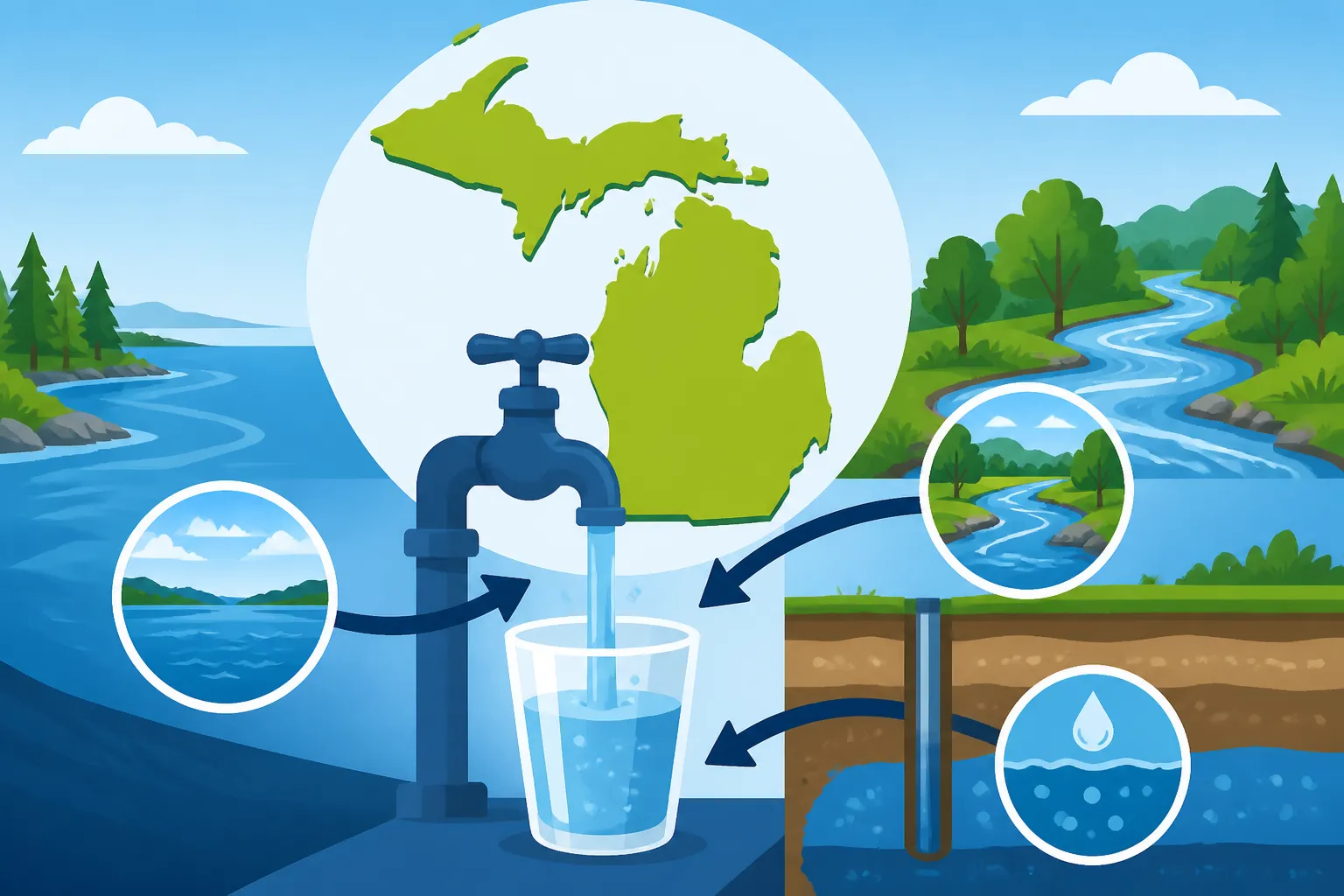
Where Michigan Tap Water Comes From: Lakes, Rivers and Groundwater
Michigan tap water does not come from one statewide source. Depending on where you live, your supplier may draw from a Great Lake, a river, or groundwater wells, then treat and deliver it through a public system. Knowing the source helps you understand what to look for in a water quality report—and what that report can and cannot tell you about the water at your own tap.
Why the source of your tap water matters
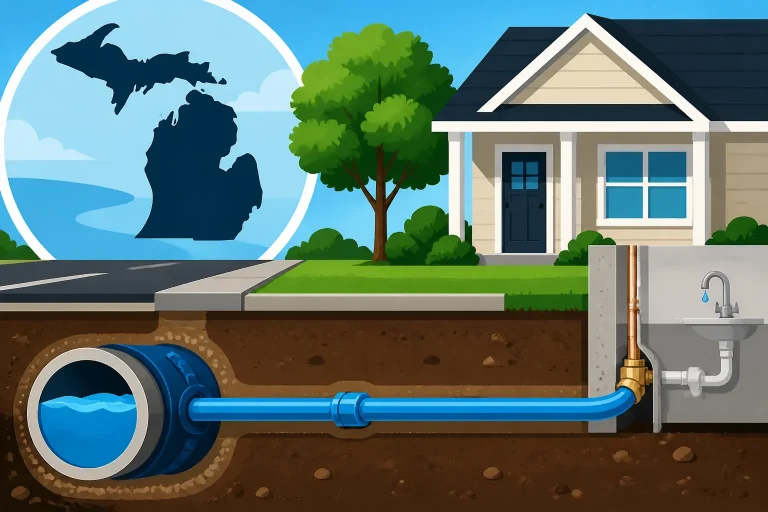
A faucet is the end of a delivery system, not a direct window into a lake or an underground aquifer. Water suppliers draw from a source, treat the water, and move it through infrastructure to homes and businesses. The source matters because it helps explain where the water begins and what conditions the supplier considers when managing and treating it.
Michigan homes may receive water from surface water, groundwater, or a combination that varies by system. Surface water includes water drawn from the Great Lakes, rivers, and other open bodies of water. Groundwater is drawn from underground through wells. A source can be close to the community it serves, or water may be supplied through a larger regional arrangement. The name of your city alone does not always identify the source behind your faucet.
Knowing the source can help you make sense of information in a consumer confidence report, sometimes called a water quality report. The report describes the public water system and the results it reports, but it is not necessarily a direct measurement of every home’s plumbing or the water coming from one particular faucet. For a closer look at that distinction, see Does Your City’s Water Report Show What Comes Out of Your Own Tap? and How to Find Your Michigan Water Supplier’s Consumer Confidence Report.
Source information is also useful when you move. Two homes in nearby communities may receive water from different systems, even if the neighborhoods look similar. A change in source can mean a different treatment approach, different report details, or a different supplier to contact with questions. That does not, by itself, show that one supply is better or worse. It means the information that applies to one address may not apply to another.
The practical goal is to identify the water supplier for your address, find out what source the supplier uses, and read the current report for that system. If your concern is a particular tap, a service line, or older indoor plumbing, source information is only one part of the investigation. Is Michigan Tap Water Safe? A Guide to Checking Your Own Supply explains how to use supply information alongside other checks.
The main sources of Michigan tap water
Great Lakes and other surface water
Surface water sits above ground in lakes, rivers, and reservoirs. In Michigan, a community system may draw from one of the Great Lakes or from another surface-water source. A lake or river may appear clear, but appearance alone does not describe its water quality. Source water can contain naturally occurring material and substances introduced by activity in its watershed, so utilities treat it before sending it through a distribution system.
A source’s location is not the whole story. Water in a lake or river is influenced by the area that drains into it, the source’s conditions, and the way the supplier operates its treatment system. A large body of water can serve as a source for a community without the household drawing water directly from the shoreline. Instead, the supplier takes water at an intake, treats it, and distributes it through the public system.
For residents, a surface-water source can help explain why reports discuss source-water protection or treatment processes. It does not tell you what is happening at a particular home’s faucet. Water can be affected by the public system and by the plumbing on the way to the tap. For a broader overview of the route from source to household, read What Is Tap Water? From Michigan Source to Kitchen Faucet.
Groundwater wells
Groundwater is held below the land surface in soil and rock formations. A public water supplier can draw it through wells, then treat or condition it as needed before distribution. In some Michigan communities, groundwater is the primary source; elsewhere, the public supply may use surface water or a different arrangement.
A well’s surroundings are relevant because water moves through the ground and can be affected by conditions in the surrounding area. That is why protection of the land around a public well can be part of how a system manages its source. Nearby contamination does not automatically mean a particular well or household tap is affected. It is a reason to rely on information tied to the correct water supply and to avoid making assumptions from a map alone.
EGLE’s Water Well Viewer is an interactive mapping system that displays water wells and information including wellhead protection areas and sites of environmental contamination. EGLE’s Water Well Viewer displays wellhead protection areas and sites of environmental contamination. These map layers can help residents see what information is available around an area, but a mapped feature is not the same thing as a result from the tap at a particular home.
The Water Well Viewer can be particularly relevant to people who want to understand nearby wells or source-protection areas. It is not a substitute for identifying the supplier that serves an address. Public water systems and private household wells are different arrangements, and a map showing wells in an area does not establish which source supplies a particular municipal connection. Surface Water or Groundwater? How Michigan Community Systems Differ offers more detail on those system differences.
A combination or regional supply
Some residents may assume that a town gets all its water from the nearest lake, river, or well. That is not always a safe assumption. A supplier may use more than one source, or a community may receive treated water through a regional arrangement rather than drawing it from a source within its borders.
The terms on a bill, city website, or report may not make the full arrangement obvious. A local utility may operate the pipes and customer service while obtaining water from a larger supplier. In that situation, the community’s water system still matters to residents, but its source may be associated with the supplier that treats or wholesales the water. Wholesale Water: When a Town Buys From a Bigger Supplier explains why the utility named on a bill may not be the same entity that draws water from the original source.
The same point applies when a system has multiple sources. A report may describe a source or treatment process at the system level, while day-to-day operations can involve more than one component. If a report is unclear, ask the supplier which source or sources serve your address and whether any regional supplier is involved. Do not assume that a nearby source is the one feeding your home.
| Source type | What it means | What it can help explain | What it does not establish by itself |
|---|---|---|---|
| Great Lake or other lake | Water is drawn from a surface-water body | Source-water context and treatment information in a supplier’s report | The exact quality of water at a household faucet |
| River or reservoir | Water is drawn from flowing or stored surface water | Why watershed conditions and source management may appear in system information | Whether a particular home has a plumbing-related issue |
| Groundwater well | Water is drawn from underground through a well | Why well locations and source protection may be relevant | Whether a mapped nearby well supplies the home |
| Regional or combined supply | Water may come from a larger supplier or multiple sources | Why the local utility and source owner may differ | Which source served the home at a particular moment |
How source water becomes tap water
The route from source to faucet has several parts. Understanding them helps avoid a common mistake: treating the natural source as if it were the same thing as finished drinking water.
A supplier first draws water from its source. The water then goes through treatment designed for that system, before it enters the distribution network. Pipes carry it to service connections and buildings. Inside a property, plumbing and fixtures make up the final part of the route. The details differ between systems, so a general description should not be taken as a complete account of a specific utility’s operations.
Treatment is meant to prepare source water for delivery as drinking water and to meet applicable requirements. The treatment process depends on the source and the supplier’s system. A public report can describe the system’s monitoring and results, but a report is not a household inspection. It does not show the condition of every pipe between the system and a particular faucet.
That distinction matters when a resident notices a change in taste, odor, or color. A change can have more than one possible cause, including system operations or plumbing within a building. The source alone does not identify the cause. Start by checking whether the supplier has reported an issue and whether the change is limited to one fixture or occurs throughout the home. Taste, Smell and Color: A Guide to Odd Tap Water in Michigan Cities and One Faucet, Hot Only or Every Tap? Tracing Discolored Water at Home can help organize those observations.
A household with a private well has a different route. The owner is responsible for understanding the well and arranging appropriate testing and maintenance, rather than relying on a municipal supplier’s consumer confidence report. A public supply report does not describe the water from a private well on a property. If you are unsure whether your home is connected to a public system or uses a private well, City Water or Private Well? How to Tell Which Your Michigan Home Has is a useful starting point.
Why sources vary from one Michigan community to another
Michigan’s geography includes large lakes, rivers, inland waters, and groundwater resources. That variety allows different communities to use different sources, but it also means there is no single answer to “Where does Michigan tap water come from?” The answer depends on the supplier serving a specific address.
Municipal boundaries can be misleading. A home inside one city may have a different supplier from a home just outside the boundary. Nearby places may share a regional supplier, or they may use separate systems. A community name is a helpful clue, not a reliable final check. Confirm the supplier using the address rather than assuming that the closest utility or body of water serves the property.
Source arrangements also shape the way reports are presented. One supplier’s report may emphasize a source-water description, while another may provide details in a different format. A community buying treated water may refer to its wholesale supplier or to a source beyond the local service area. If you see unfamiliar terms, compare the report with the supplier’s explanation and ask which entity is responsible for source water, treatment, and distribution.
The source can also change over time. A supplier may alter how it obtains water, including arrangements with another system. If you hear about a change, look for an official notice or current report rather than relying on a rumor or an old account of the system. Historical information can explain past decisions, but it may not describe the supply serving your home now.
For residents moving between Michigan communities, reports should be compared carefully. A difference in source does not automatically mean a difference in safety, and a similar source does not guarantee identical treatment or distribution. The relevant comparison is between the current reports and systems that serve the actual addresses. Comparing Water Quality Reports Before a Move Between Michigan Cities can help make that comparison more useful.
How to find the source for your address
Use a short sequence of checks rather than guessing from geography or a city name.
- Identify the supplier. Check a recent water bill, lease documents, or the property’s service information. If the supplier is not clear, ask the property manager or local water office which public system serves the address. For more help, see Which Utility Serves This Address? A Water Lookup Guide.
- Find the supplier’s current water quality report. Look for the report for the system that serves the address, not simply a report with a familiar city name. If the local system buys water from another supplier, check whether the report explains that relationship.
- Look for source-water language. Search within the report for information about the source, source-water assessment, wells, surface water, or a regional supplier. If the wording is unclear, ask the supplier what source or sources are used and whether the arrangement is shared.
- Check whether the report matches your concern. A system report is useful for understanding public-supply monitoring. It may not answer a question about lead in an individual home’s plumbing, a private well, or a change isolated to one faucet.
- Use maps as context, not as a verdict. Mapping tools can provide useful information about wells and environmental features, but a nearby point on a map does not prove that it supplies your home or that a contaminant is present in your tap water.
For public water supply information, the MPART geographic information system includes public water supply results among its datasets. That can help residents locate relevant public-supply information, but it should be read as one source of context rather than a replacement for the supplier’s report or an address-specific answer from the supplier.
For groundwater questions, EGLE’s Water Well Viewer displays wellhead protection areas and sites of environmental contamination. Those layers can help you understand what is mapped in an area. They do not, on their own, establish the source of your household’s water or confirm a water-quality result at the tap.
If you are researching a property before buying or renting, ask for the supplier’s name and the current report that applies to the address. Do not rely only on a previous owner’s description, a listing, or a report for a neighboring community. If the property uses a private well, ask for well test records rather than a public-supply report. New to Michigan? A Checklist for Getting to Know Your Tap Water and Renting in Michigan: How to Look Up Your Building’s Water Quality cover common address and housing questions.
What the source tells you—and what it cannot
Knowing the source gives useful context, but it is not a complete water-quality assessment. A source label such as “groundwater” or “surface water” cannot tell you what a household’s water tastes like, whether a faucet has a plumbing issue, or whether a specific contaminant is present in a particular sample. Those questions require the right report, inspection, or test.
A consumer confidence report describes the public system, not every individual home. Sampling is designed to provide information about the system under its monitoring approach. Conditions can differ within a distribution network, and a home’s plumbing can affect water after it enters the building. A result reported for the system should not be interpreted as a direct test of every faucet.
Likewise, proximity is not proof of a connection. A home near a river may receive groundwater or water from a regional supplier. A mapped well nearby may not be part of the public system serving the address. A contamination site shown on a map does not, by itself, show that water from the site has reached a source or a household tap. Use maps to identify questions, then check the actual supplier and relevant test information.
Source water is also not the same as untreated water at the faucet. Public water is treated and distributed before it reaches customers. A concern about the raw source should be considered alongside the supplier’s treatment and monitoring information. If the supplier’s report does not answer a question, contact the supplier for clarification and ask what data apply to the system.
For questions about a private well, the testing plan depends on the well and the property. A nearby public system’s report is not a substitute. See A Homeowner’s Starting Guide to Testing a Private Well in Michigan for how private-well testing differs. If you are not sure whether your supply is public or private, resolve that first; the appropriate records and next steps depend on the answer.
Water quality concerns should be matched to the right evidence. A taste or odor change may call for a supplier inquiry and an assessment of where the symptom occurs. A concern about a known plumbing material may require a different approach from reading the source description. A possible health concern should be discussed with the local health department or a medical professional, rather than inferred from the name of a source or a map entry.
The most useful takeaway is modest but practical: identify the system, read the information for that system, and separate source-water context from the condition of water at your own tap. That keeps a map, a report, and a household observation in their proper roles.
Frequently Asked Questions
Does all Michigan tap water come from the Great Lakes?
No. Michigan communities may use surface water, groundwater, or a regional supply arrangement. The source depends on the water system serving the address, so check the supplier’s report rather than assuming the nearest Great Lake is the source.
Can I tell my water source from my city name?
Not reliably. A city may have more than one arrangement, and nearby addresses can be served by different systems. Confirm the supplier for the specific address and check that supplier’s current report.
Does a nearby well on a map supply my home?
Not necessarily. A mapped well can provide context, but proximity alone does not show that it supplies a particular address. Ask the public supplier which source serves your home, or confirm whether the property uses a private well.
Does a water quality report tell me exactly what is in my faucet?
It describes information about the public water system, but it is not a test of every home’s plumbing or every tap. If your concern is specific to your home, identify the issue and choose an appropriate follow-up, such as asking the supplier, arranging a suitable test, or having plumbing assessed.
Sources
- Michigan Department of Environment, Great Lakes, and Energy (checked November 13, 2026)
- Michigan Department of Environment, Great Lakes, and Energy (checked April 15, 2026)
- Michigan PFAS Action Response Team (checked November 13, 2026)
Disclaimer
This article is for general informational purposes only and does not constitute professional advice. Laws, prices and regulations vary by location and change over time. Consult a qualified professional for guidance on your specific situation. Michigan Water Guide is not a government agency or water utility and is not affiliated with any public water system.