Michigan Water Quality Reports: A Resident’s Guide to the CCR
A Michigan water quality report can look reassuring, alarming or simply hard to decode. The Consumer Confidence Report (CCR) summarizes information about a public water system, but it does not tell you everything about the water at your own tap. Here’s how to find the right report, interpret its tables and use it to decide what to check next.
What a CCR tells you—and what it cannot tell you
A Consumer Confidence Report is a summary of drinking water quality for a particular public water system. It is meant to help residents understand where the system’s water comes from, what was detected in the water it monitors, and how those results compare with applicable standards. The report may also explain treatment, monitoring, and any violations or required follow-up.
The most important boundary to keep in mind is that a CCR describes the system covered by the report. It is not a test of the water from your kitchen faucet. Water can travel through service lines, building plumbing, fixtures and household equipment after it leaves the utility’s distribution system. Conditions inside a home can therefore differ from the system-wide information in a report.
That distinction does not make a CCR unhelpful. It gives you a useful starting point: a picture of the water system’s reported results and the monitoring it performed. It can help you identify what the supplier tests for, whether any results need explanation, and what questions to ask if your home has a specific concern.
A report also has limits that are easy to overlook. It may summarize sampling over a reporting period rather than describe today’s water at your address. Its sampling locations may not include your home. A result reported for a system does not necessarily show what happens in every neighborhood, building or plumbing fixture. And a contaminant that is not listed may not have been tested for in that report, or may be presented under a different name.
When reading a CCR, separate these questions:
- What does the report say about the water system? Look for its source, the contaminants monitored and detected, how results are presented, and whether the report notes a compliance issue.
- What does the report say about my building or tap? Usually, a system report cannot answer that directly. Your service line, indoor plumbing, and any local sampling history may matter.
- What should I do if I have a specific concern? Use the report to decide what information to request or whether a tap sample or other follow-up makes sense.
For context about how system-wide information relates to a household faucet, see Does Your City’s Water Report Show What Comes Out of Your Own Tap?. For a broader starting point on what a water quality report measures, What Is Water Quality? How Michigan Utilities Measure Tap Water explains the kinds of information that may appear in utility reporting.
Find the report for your actual water supplier
The first challenge is often not reading the report, but finding the correct one. The city or mailing address alone may not identify the water supplier. A home may receive water from a regional supplier through a local community system, and nearby addresses can fall under different systems. An apartment or condominium may also have a different arrangement from a nearby single-family home.
Start with the water bill, account portal, lease documents or property records to identify the supplier serving the address. If those do not make it clear, ask the property manager or contact the utility listed on the bill. If a local system purchases water from a larger supplier, check whether the local report describes the water delivered to customers or whether it directs residents to another report for source-water information. Do not assume that a report for a neighboring city applies to your address.
A good report match should make sense for the place where you live. Check the system name, service area and report title rather than relying only on a search result or a familiar city name. If you moved recently, confirm that the report covers your current address and the relevant reporting period. For help locating the supplier and its report, see How to Find Your Michigan Water Supplier’s Consumer Confidence Report and Which Utility Serves This Address? A Water Lookup Guide.
If you rent, ask the landlord or building manager which supplier serves the property and where residents can review the report. A building can receive water from a public system, but its internal plumbing is not described by the utility’s system-wide results. If you are not sure how your rental is supplied, How Michigan Renters Can Find Out Who Supplies Their Building’s Water covers the questions that can help clarify it.
A report can also be missing from a mailing or account notice without being impossible to locate. Search the supplier’s official website using the system name and terms such as “Consumer Confidence Report” or “water quality report.” If you cannot find the report, ask the supplier where customers can review it and whether a separate report applies to your service area. No Consumer Confidence Report in the Mail? Steps for Michigan Homes can help you work through that situation.
The Michigan PFAS Action Response Team’s geographic information system includes public water supply results among its datasets. That can be useful when you are looking for public water supply information, but a map or dataset is not a substitute for confirming which supplier serves your home or reading the supplier’s report. For help understanding what such mapping can and cannot show, see Where to Look Up PFAS Results for Your Michigan Public Water Supply.
Read the report from the top before jumping to the table
A CCR is easier to interpret when you first establish what it covers. Before focusing on a contaminant result, look for the report’s system name, description of the service area, reporting period and explanation of the source water. Those details tell you whose results you are reading and how the supplier describes its water supply.
Check the source and treatment description
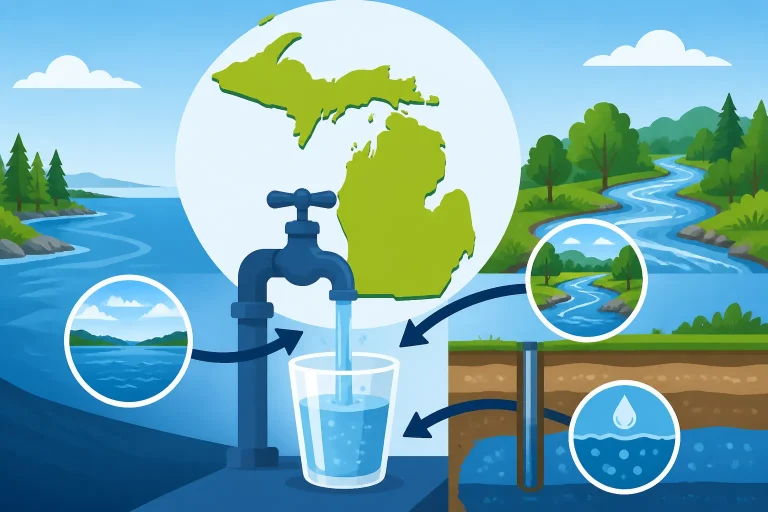
The report may describe whether the system relies on surface water, groundwater or a combination, and may summarize treatment steps. This information gives context for how water is collected and processed. It does not, by itself, tell you that a particular contaminant is present or absent. A water source can inform what a supplier monitors, but results and treatment details are the evidence to examine.
The supplier may also explain whether it buys water from another system. In that case, the local report may describe the water as delivered to the community, while information about the original source or treatment may appear elsewhere. If the relationship is unclear, ask the supplier which report best explains the water delivered to your address. Wholesale Water: When a Town Buys From a Bigger Supplier explains why a community’s supplier and its water source are not always the same thing.
Read the report’s definitions
Reports often include a glossary or a short explanation of standards and units. Read it before comparing values. Terms such as maximum contaminant level, maximum contaminant level goal, treatment technique, action level, detection and compliance do not all mean the same thing.
A maximum contaminant level (MCL) is a regulatory limit used for a contaminant. A maximum contaminant level goal (MCLG) is a different kind of benchmark, not the same as the enforceable limit. Some contaminants may be governed by a treatment technique rather than a simple concentration limit. An action level is another distinct term and should not be treated as interchangeable with an MCL.
The report’s own definitions and notes matter because the table may use abbreviations or technical terms. If the meaning is still unclear, do not infer that a result is safe or unsafe from a label alone. MCLs, Action Levels and Units: Reading a Michigan Water Report Table walks through the differences that commonly cause confusion.
Look for the compliance explanation
A report may have a separate section describing monitoring or compliance issues. Read that explanation alongside the contaminant table. A result can appear in a table with context about when or how it was collected, while a notice elsewhere explains a violation or a missed monitoring requirement. Conversely, a detection in a table does not automatically mean the supplier violated a standard.
If the report describes a violation, read the supplier’s explanation and any corrective actions or follow-up information. The wording may distinguish between a problem with a measured result and a problem with monitoring or reporting. If a notice leaves you uncertain about what happened or whether the issue has been resolved, ask the supplier for the details and any relevant updates.
Make sense of the contaminant table
The table is often the part residents turn to first, but it can be difficult to read without knowing what each column represents. The exact layout varies. One report may show a range, while another may emphasize a highest result or a compliance value. Use the table heading, footnotes and definitions to understand what is being compared.
| Table item | What to check | What not to assume |
|---|---|---|
| Contaminant name | Confirm the exact substance or group listed. | Similar names do not always refer to the same test or category. |
| Result or range | Check whether the report gives a range, an average, a highest result or another summary. | A summary is not necessarily a result from your home. |
| Units | Read the units before comparing values. | Two numbers with different units cannot be compared directly without a valid conversion. |
| MCL or other standard | Check which benchmark applies and how the report defines it. | An MCL, MCLG, action level and treatment technique are not interchangeable. |
| Detection notation | Read how the report defines “detected,” “not detected” or a reporting limit. | “Not detected” does not necessarily mean absolute zero. |
| Source or likely origin | Read the explanation the supplier provides. | A listed possible source does not prove the contaminant came from that source locally. |
| Violation or compliance note | Read the table and any related explanation together. | A detection alone does not establish a violation. |
Start with the units and reporting format
Units are essential. The same contaminant can be reported using different units, and a number without its unit is incomplete information. Before comparing a result with a standard, make sure both are expressed in compatible units. If the report uses an unfamiliar abbreviation, use the report’s definitions or ask the supplier to explain it.
Then identify what the reported figure represents. It might be an average, a range across samples, a highest result, or another summary specified by the report. Those formats answer different questions. A range may show variation among samples; an average summarizes results in a different way. The table’s footnotes should state how values are calculated or which value is used for comparison.
Do not compare a number in one report with a number from another city until you know that the units, sampling approach, reporting period and summary method are comparable. A higher-looking value is not necessarily evidence that one system performed worse if the figures represent different things.
Understand detections and reporting limits
A report may use terms such as “detected,” “not detected,” or a symbol to describe the result. Check the report’s own explanation. A non-detection means the test did not report a result at or above the method’s stated reporting threshold; it does not necessarily mean the substance is absent in every possible sense. A detected result means the test reported a value, but it still needs to be read alongside the applicable standard and the report’s interpretation.
A result marked with a footnote may have special context. The sample might have been collected at a particular monitoring point, analyzed under a specific method, or summarized in a way that differs from other rows. Read all notes tied to the result before drawing a conclusion.
For a deeper look at the wording used in report tables, see Does ‘Not Detected’ on a Michigan Water Test Mean Zero?. If the table does not explain the reporting threshold or method, ask the supplier what the notation means for that specific result.
Distinguish a detection from a violation
A contaminant can be detected without the report indicating a violation. The relevant standard, the way results are calculated and the applicable monitoring requirements all matter. That is why a table should be read as a whole rather than by searching for the word “detected” and stopping there.
The reverse also matters: a compliance issue may relate to a monitoring or reporting requirement, not necessarily a reported contaminant level. A violation notice should explain what requirement was not met and what steps the system took or plans to take. If it does not, ask the supplier to explain the issue in practical terms.
Do not use a single line in the table to make a claim about the water at an individual tap. The result is about the system sampling described in the report. A specific household may need different information, especially where plumbing materials, building conditions or a private water source are involved.
Pay special attention to lead and copper information
Lead and copper results need careful reading because sampling at selected taps is not the same as testing every home. If a CCR includes lead and copper information, look for the explanation of how samples were collected, how results are summarized, which benchmark is used, and what the report says about follow-up. The table may use an action level rather than an MCL, so check the report’s definitions.
A system-wide sampling result cannot tell you the lead concentration in your own faucet water. Results can vary by building and plumbing, and the presence of a lead service line or older plumbing may be important even when a system report describes overall results. If you need to know about your home, review the service-line information for your address and ask the supplier about sampling options.
A result below an action level is not a guarantee that every home’s tap has the same result. The action level is a system-level measure used in a defined monitoring context, not a household test result. For more on this distinction, see Does a Result Under Michigan’s Lead Action Level Mean Safe Water? and Reading the Lead and Copper Lines of a Michigan Water Quality Report.
If you do not know what material your service line is made of, ask the supplier how to check its records and what to do if the material is unknown. How to Tell Whether Your Michigan Service Line Is Lead explains the kinds of information residents can look for. If you want a sample from your own tap, How to Get Michigan Tap Water Tested for Lead, Step by Step covers the practical questions about arranging a test and understanding its result.
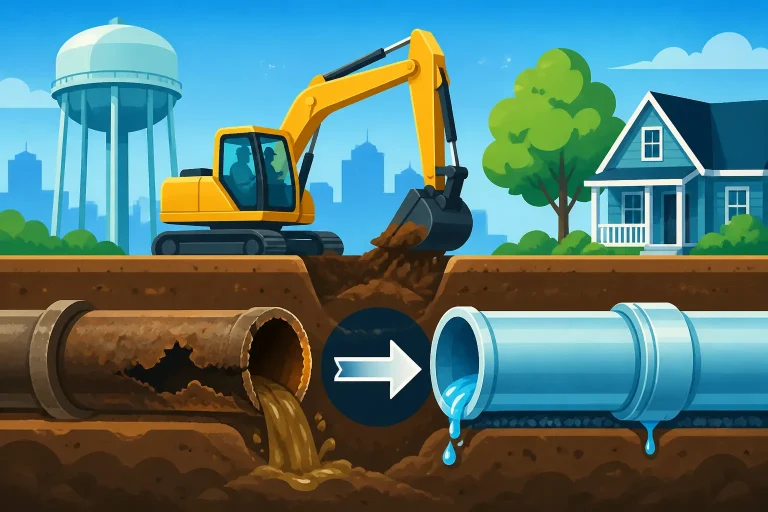
Household plumbing can also matter after a service-line replacement. Work on a service line does not necessarily remove every possible source of lead from indoor plumbing. If the report has prompted questions about a recent pipe project or remaining plumbing, Lead After Line Replacement: What Can Linger in Michigan Home Plumbing provides useful context.
Avoid treating a generic filter claim as proof that your water has been tested or that a particular concern has been addressed. If you are considering a treatment device, first identify the contaminant and compare the product’s certification with your own water test results. The report can help identify questions, but it does not replace address-specific testing when that is what you need.
Use the CCR to decide what to ask or check next
A useful way to read a report is to turn each uncertainty into a specific question. Instead of asking whether the water is simply “good” or “bad,” identify what information is missing: the supplier, a table abbreviation, a sampling location, a specific contaminant, or a difference between system results and household plumbing.
Use a practical sequence:
- Confirm the report matches your address. Check the system name and service area, and ask the supplier if the boundary is unclear.
- Read the source and treatment description. Note whether the system identifies a source or purchases water from another supplier.
- Review the contaminant table and definitions together. Check units, reporting format, applicable standards and footnotes.
- Read any compliance or monitoring notices. Look for what happened, what the system says it did, and whether it describes follow-up.
- Identify whether your question is system-wide or household-specific. A CCR may address the first, while a home test or plumbing investigation may be needed for the second.
- Ask a focused follow-up question. Request an explanation of the specific table entry, sample location, result format or next step that concerns you.
If your concern is a change in taste, odor or color, the CCR may provide background but is not a diagnosis of the immediate cause. A sudden change can have different explanations, and the supplier is the right place to ask whether there is a current system notice or work in your area. Taste, Smell and Color: A Guide to Odd Tap Water in Michigan Cities offers a way to think through those symptoms and what information to gather.
If you are concerned about a contaminant not shown in the report, check whether the supplier lists it under a different name or in a separate notice. A blank or absent row should not be interpreted as a test result. Ask whether the contaminant was monitored, what information is available for the system, and whether a separate household test is appropriate.
For concerns about possible health effects, ask your local health department or a medical professional rather than relying on a report table to answer a personal health question. A CCR provides water-system information; it is not an individual medical assessment.
For residents using a private well, a municipal CCR usually does not describe the water from that well. Private wells need their own testing and interpretation. A Homeowner’s Starting Guide to Testing a Private Well in Michigan explains how to begin, while Reading a Michigan Water Test Report: Limits, Units and Next Steps can help with the different kind of report a household lab may provide.
Keep the report in perspective
A CCR is valuable when used for the question it can answer: what the report says about the public water system it covers. It can orient you to the system’s source, reported monitoring and contaminant results, and any compliance explanation included in the document. It can also give you better questions to ask.
It is not a complete assessment of every address, building or faucet. It cannot confirm the material of your service line, test the plumbing inside your home or establish a contaminant level at your kitchen tap. A result for a water system should not be treated as a personal sample, and a missing result should not be mistaken for proof that a substance is absent.
A measured result also needs context. Check the unit, sampling method, summary format and applicable benchmark. Read the footnotes and explanatory sections, not only the number in the row. If a term or result remains unclear, ask the supplier to explain what it means for the system and where the sample came from.
When the issue is specific to your home, move from the system report to address-specific information. That may mean checking service-line records, asking about a household sampling option, arranging a suitable test, or consulting a qualified professional about plumbing or treatment. Choose any treatment only after identifying the water concern and checking that the device is certified for the reduction you need. A report is a starting point for better decisions, not a substitute for evidence from your own tap when that evidence is needed.
Frequently Asked Questions
Does a CCR show the water quality at my kitchen faucet?
No. A CCR describes the public water system covered by the report. It does not test the plumbing, fixtures or water at your individual tap. Household-specific concerns may require address records, a tap sample or other follow-up.
Why is a contaminant detected if the report says the system complies?
Detection and violation are not the same thing. The relevant standard, result format and monitoring rules matter. Read the table definitions and any compliance explanation, and ask the supplier to clarify a result you cannot interpret.
Does “not detected” mean a contaminant is completely absent?
Not necessarily. The report’s detection notation generally relates to what the test method could report. Check its explanation of the method or reporting threshold before drawing a conclusion.
Can I use a nearby city’s CCR if I cannot find mine?
Do not assume that a nearby report applies to your address. Confirm the supplier and service area with the utility or property manager, then use the report identified for that system.
What should I do if the report raises a concern?
First identify whether the concern is about the system or your home. Ask the supplier about system results or notices. For a household-specific concern, ask about appropriate sampling or consult a qualified professional. For health questions, contact your local health department or a medical professional.
Sources
- Michigan PFAS Action Response Team (checked November 13, 2026)
Disclaimer
This article is for general informational purposes only and does not constitute professional advice. Laws, prices and regulations vary by location and change over time. Consult a qualified professional for guidance on your specific situation. Michigan Water Guide is not a government agency or water utility and is not affiliated with any public water system.